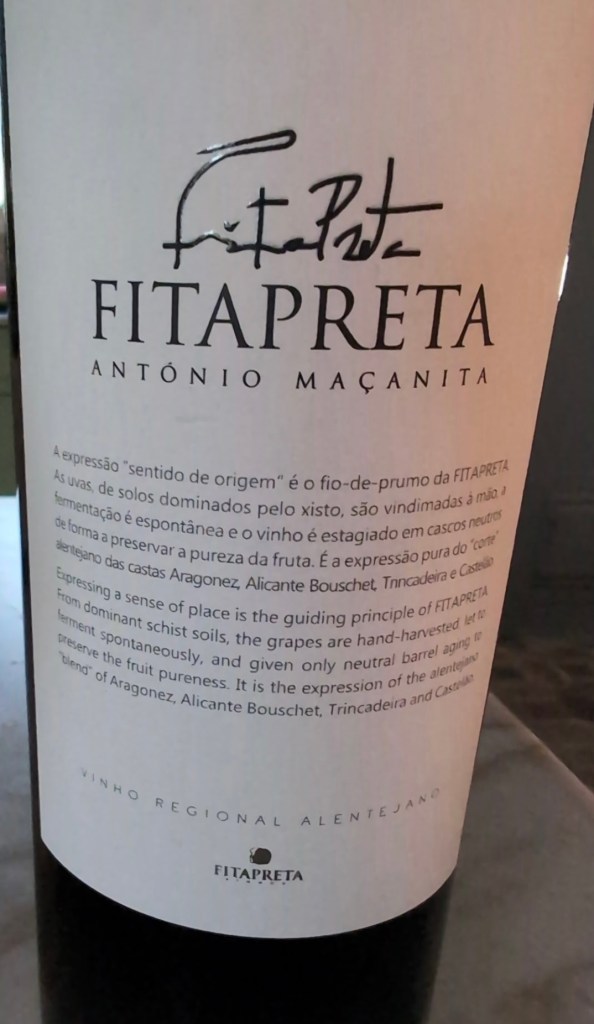
To drink Fitapreta is to drink with ghosts—the kind that do not haunt, but command. In each glass, António Maçanita has trapped the same fury that Luís de Camões once bound into verse. This is not wine for the docile or the merely curious. This is wine for the discontented, for those who feel in their marrow what Camões wrote of the Portuguese spirit: “Dai-me uma fúria grande e sonorosa” (“Give me a great and sonorous fury,” Canto I, 4). Fitapreta is not designed to comfort—it’s designed to summon. And what it summons is a memory: of empire, of defiance, of men who walked toward the edge of the known world with their backs straight and their fates unrepentant.
Risk is the wine’s blood. Camões consecrated risk as the original virtue of the Portuguese: “Ó fortes, que por obras valerosas / Se vão da lei da Morte libertando” (“O brave men, whose valorous deeds / Free them from the law of Death,” Canto I, 2). Maçanita’s viticultural decisions mirror that ethos. Who else has the audacity to farm abandoned varietals in Alentejo’s punishing heat, to vinify wines with minimal intervention in a market addicted to polish and predictability? To make Fitapreta is to stand at the prow of one’s own fleet, daring the storm to strike. It is a practice not of safety, but of sovereignty.
Adventure, in Camões’ telling, is both sublime and perilous—a dance with fate under black sails. The poet’s Adamastor does not merely threaten death; he incarnates it: “E eu sou aquele oculto e grande Cabo / A quem chamais vós outros Tormentório” (“I am that hidden and mighty Cape / Which you call Tormentor,” Canto V, 39). Maçanita’s wines speak in the same register. They resist easy drinking. They announce themselves with tension, with spice, with wild mineral veins that cut across the palate like rigging in a gale. Fitapreta is no perfumed token of terroir—it is a navigational act, a wine that demands direction and dares the drinker to take the helm.
Assertiveness here is not swagger—it is the quiet certainty of purpose. When Camões invokes Portugal’s right to glory, it is not meek: “Cessem do sábio Grego e do Troiano / As navegações grandes que fizeram” (“Let the voyages of the Greek and Trojan sages / Cease to be praised,” Canto I, 3). The poet replaces Homeric antiquity with Portuguese modernity, just as Maçanita replaces tired oenological mimicry with native command. Fitapreta does not apologize for being Portuguese. It asserts that to be Alentejano is not to be lesser—it is to be elemental. Granite, heat, tension, structure—this is a wine that knows what it is, and says so without blinking.
Grit, finally, is the muscle beneath it all. Camões knew hardship intimately—wounded in Ceuta, shipwrecked near Cambodia, begging in the streets of Lisbon. Yet even from ruin, he composed the epic of a nation: “E entre gente remota edificaram / Novo Reino, que tanto sublimaram” (“And among distant peoples they established / A new kingdom, which they so greatly exalted,” Canto I, 20). Likewise, Maçanita doesn’t craft his wines from privilege, but from pressure—economic, climatic, cultural. Alentejo is a land of struggle, and Fitapreta bears its scars like medals. This is not a wine made to charm. It is a wine made to last.
Camões gave Portugal its voice; Maçanita distills that voice into matter. In Fitapreta, we taste the persistence of a myth, reforged in iron and blackberry, in salt and sun. This wine does not simply tell a story—it continues one. A story of men who defy, who wander, who endure. A story that Camões began with a quill—and that Maçanita now continues, bottle by bottle, like a cannon shot across time.

 NEUwine
Leave a comment