Blog

  • What the Smoke Knows

    It has been six months since our trip to Mexico.

    Oaxaca

    A mezcalero deep in the mountains above Huatulco hands us a shot glass. The liquid inside has been infused with local flora: herbs and roots whose names we won’t remember but whose effect we will. This is not a tasting. This is an introduction. Mexico does not offer itself gradually. It opens all at once, from the inside out, and asks whether we were ready for it.

    We came for a wedding. Todd and Ashley chose this coast because some places do not merely host a ceremony-they make it real. The reception was set on the beach. The Huatulco Pacific waters absorbed the music. The hills absorbed the light. The vows that were made that evening, the landscape bore witness and the landscape is ancient. It does not forget.

    But Dawn and I planned to extend our trip to Mexico with another mission: to experience Mexico’s art- especially its gastronomy and wine.

    On our first dining out experience we found ourselves sharing a table with Jennifer, Ashley’s cousin, and John from Washington state. These things happen when you travel with intention- you find the people who travel the same way. Within ten minutes we were sharing our love for Nebbiolo. There was a Mexican Nebbiolo on the menu. But it was unrecognizable. If you had given me a blind taste test, I would have said, “shit- a big ass wine from California like a Pinot Noir blended with Syrah or Zinfandel?” Totally rude but, talking about terroir! I am glad I was not the only one who didn’t like the wine. Phew! We moved on to experience other wines. The Monte Xanic Chenin Blanc & Colombard from Valle De Guadalupe Baja was harmonious in aroma, taste and body and offered some acidity despite its ripeness. Together, it danced beautifully in our mouths with the rich grilled grouper in a mole and lemon butter sauce.
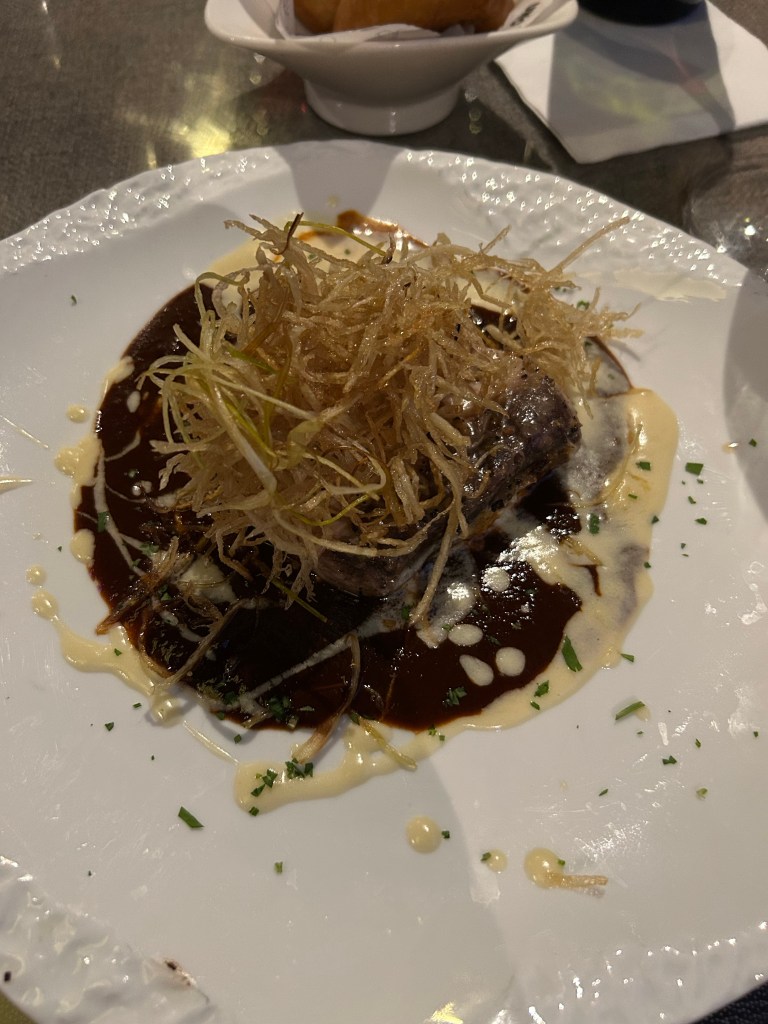
    The food in Oaxaca does not ask for your opinion. It asks for your attention. At the restaurant Aroma where we dined and around town, the mole tradition revealed itself in layers: not as a single preparation but as a philosophy. Mole negro is built on cacao, dried chiles, charred tomato, and time. It is simultaneously ancient and alive, and when it appears on a plate under braised meat with a garnish of crispy leek, it has not become something else. It has become more fully itself.

    The next day, we stopped at the local mercado. Oaxacan markets operate on a different frequency from tourist commerce. Lots of merchandise everywhere- shirts, statues, souvenirs. But the dried chiles hung in curtains got my attention as did the mole pastes in terracotta jars. The air tasted of chocolate and woodsmoke and something older than either.

    It was at a family-run eatery inside the mercado that we met a man whose name we never caught but whose presence stayed. He ran the operation with the quiet authority of someone who has always understood that feeding people is a form of love. He brought us chilichilles verdes and grilled steak in mole. The mole was thinner than Aroma’s, but equally complex. And then he sat with us, talked softly, in the way, that only people who have no reason to perform hospitality actually do.
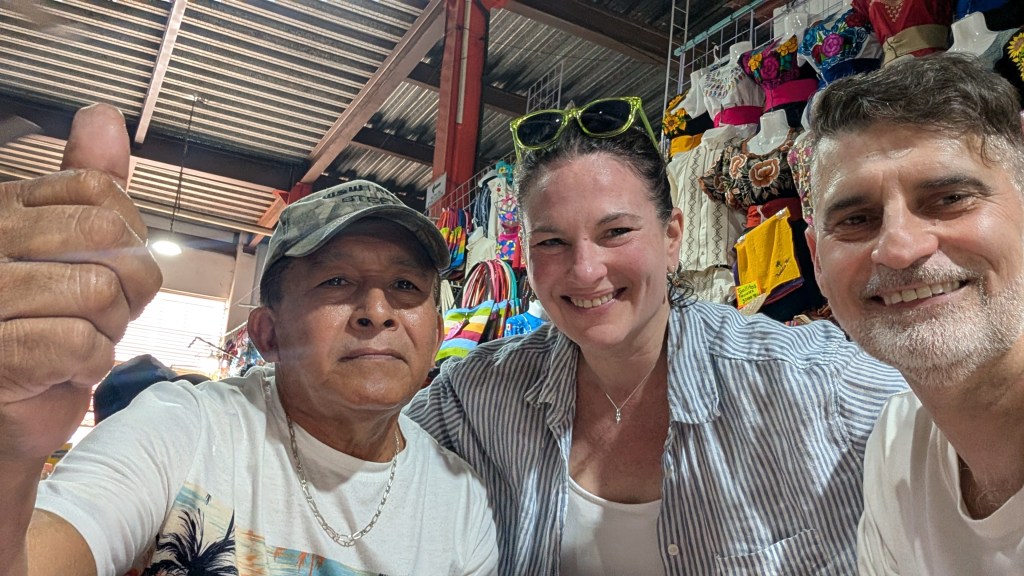
    By Monday morning, when we sat down to the wedding brunch and said goodbye to the coast, Oaxaca had made us feel that we had been experiencing something real. LCD Soundsystem’s James Murphy sang in Losing My Edge “you want to make something real…you want to make a Yaz record”. Yeah, we were making a Yaz record.

    Mexico City is three hours by air from Huatulco and approximately five centuries in sensibility. You leave a coast that operates on biological time- tides, harvests, the slow fermentation of agave in clay pots, and arrive in a metropolis of twenty-two million people that has been building, tearing down, and rebuilding itself since before the Spanish arrived to destroy it the first time. The city does not reconcile its contradictions. It wears them.

    Mexico City

    We stayed at Casa Decu in the Colonia Condesa. Art Deco buildings, jacaranda trees over wide sidewalks, restaurants whose menus read as arguments about what Mexican cuisine has the right to become. We were ready to continue our mission.

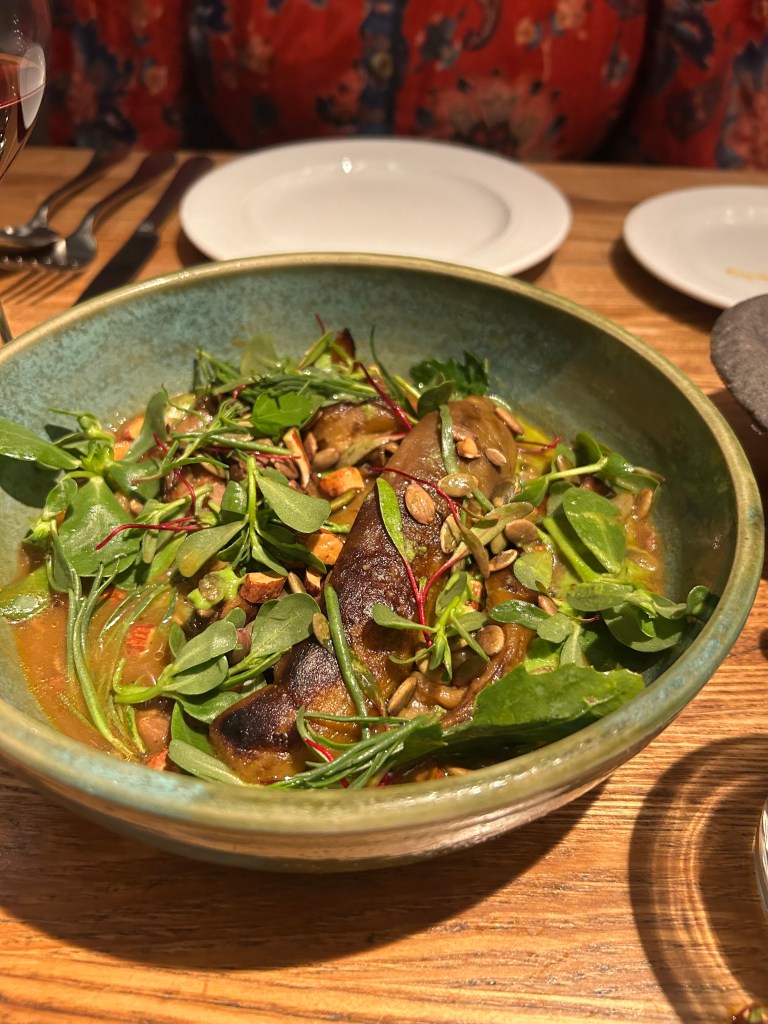
    Our first dinner was at Merotoro. Our waiter was new and appeared nervous. We ordered a Vena Cava Big Blend 2021 from Valle de Guadalupe in Baja. This big wine, ended up being way too big for the dishes we ordered. Made from Tempranillo, Cabernet, and Syrah, it needed an aged Texas ribeye steak rather than the delicate beef stew with fresh greens that we had. Reflecting back, I believe that we were also as nervous as our waiter with our first CDMX restaurant.
    Day two in the capital began in a chaotic manner with some transportation miss-happenings. Eventually, we made it to Coyoacán. This neighborhood does not belong to the same temporal register as the rest of CDMX. It is cobblestoned, leafy, self-aware. Diego Rivera and Frida Kahlo lived here. Leon Trotsky “got an ice-pick that made his ears burn” as Hugh Cornwell so bluntly spew in No More Heroes. History in Mexico does not stay in the past. It keeps appointments.

    The Museo Frida Kahlo, La Casa Azul, is one of the most intimate famous place I have ever been. The yellow shelves holding Talavera pottery. The folk masks watching from the walls. The still life paintings that are not merely still but accumulated the evidence of a life so interior it could only find expression in color. The draped stone figures glimpsed through iron gates in the courtyard, half-visible, suggest restoration or concealment, and somehow this feels correct. Frida Kahlo spent her entire life in the process of being uncovered. Two hours inside that house and you understand that her art was not a response to her pain. Her art was the structure she built to contain it. The pain was the material. The passion was the architecture.

    We walked out into the Coyoacán afternoon and sat down to lunch at Los Danzantes, where the food is rooted in traditional Mexican technique and the execution is contemporary without apology. We both knew that this week was building toward something special in terms of food and art. But holy mole! (yeah cheesy but I can’t help it). The multicolored tortillas, the short rib pulled meat in mole was perfect with the Monte Xanic 2024- Rose and Sauvignon Blanc.
    The next morning we followed Rivera’s murals at the Secretaría de Educación Pública, wall after wall, room after room of painted argument, the history of Mexico told not as a procession of dates but as a confrontation between labor and power, between indigenous memory and colonial amnesia. Brilliant. Rivera painted with the confidence of a man who believed painting could change things. He was right about the painting. He was optimistic about the things.

    After a 4.4 earthquake on the Richter’s scale,we lunched at Balcón del Zócalo, on a rooftop terrace overlooking the historic center. The Palacio de Bellas Artes rose to the west. The Cathedral and the Templo Mayor held their ground below. There is something about eating and drinking above a city that has survived conquest, earthquake, revolution, and the slow violence of modernity: it makes the glass in your hand feel like a comment. I photographed mine: a Mexican orange wine- Bichi La Gorda Yori- a Chenin Blanc based wine fermented in concrete amphorae with skin contact. Amber and opaque, and in the curved surface of the Riedel glass, the towers of the Bellas Artes were reflected upside down and perfectly intact. It was perfect. The ancient city caught inside a fermentation that didn’t exist here five hundred years ago and now does with complete conviction.

    An then there was food. They brought bread first. Two kinds. A white roll, open-crumbed and honest. And a sourdough made with cacao, dark all the way through, served with a quenelle of cacao butter on a small stone tile. The bread was not a gesture. It was a thesis statement. Cacao in Mesoamerica predates every other use to which the world has subsequently put it. To bake it into bread and serve it as the opening act of a meal that will close with mole negro is to arrange the whole history of the ingredient into a single sitting.

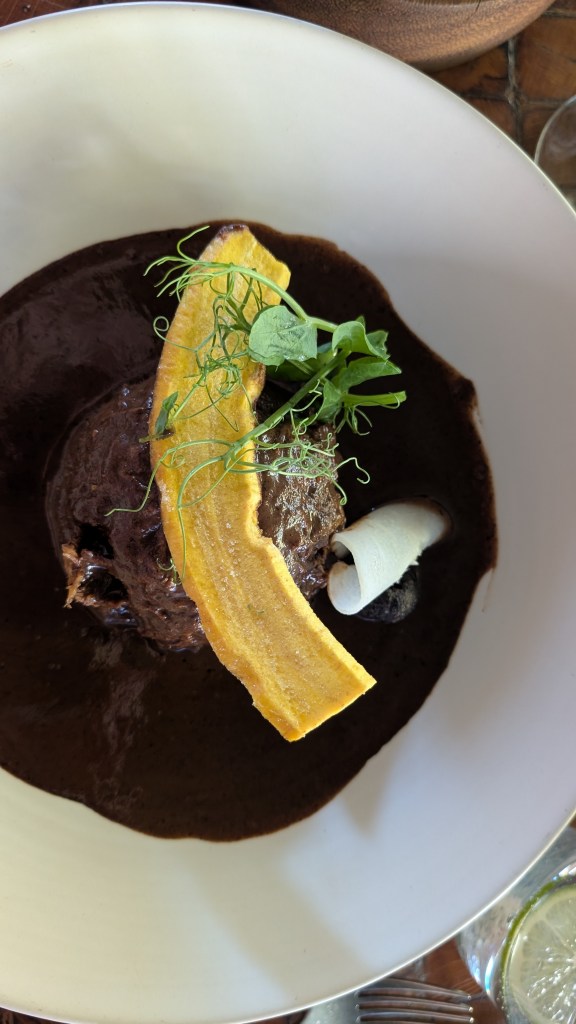
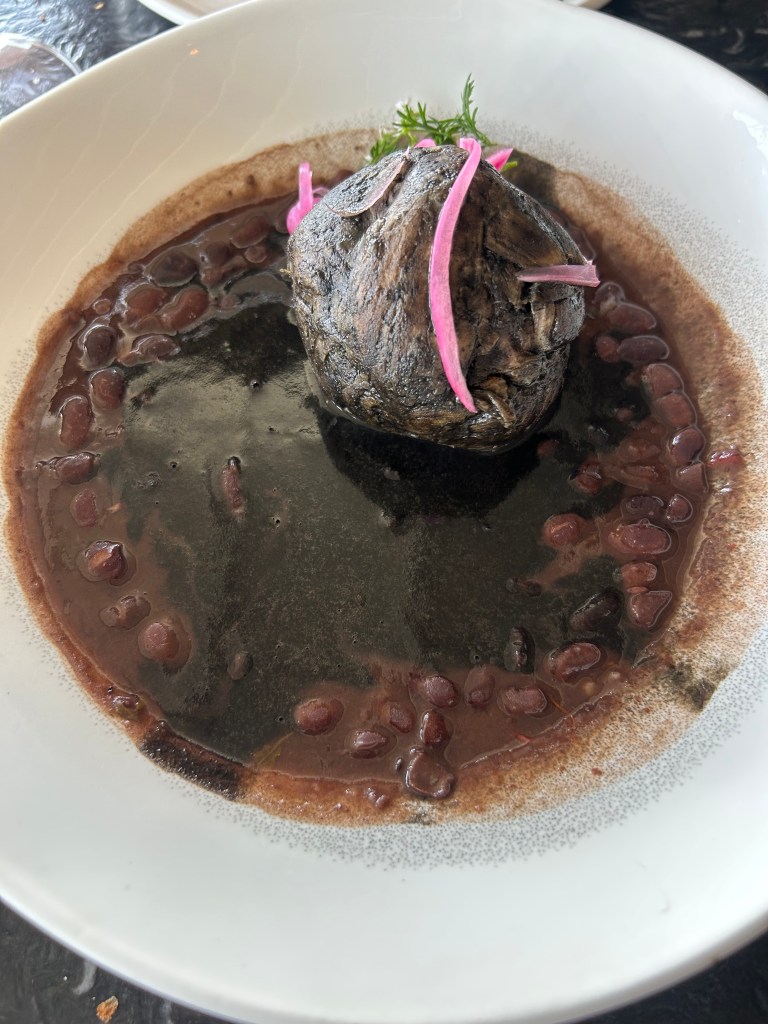
    The mole negro arrived later around a whole braised mass of pork shoulder, sitting in a bowl of black bean broth scattered with whole beans, a streak of pickled pink onion on top, a sprig of dill. After the Casa Azul’s riot of color, it felt like the city exhaling. With the mole I drank the orange Chenin Blanc while Dawn had a glass of Hacienda Encinillas, a Bordeaux blend from Chihuahua, of all places, from an estate whose colonial roots stretch back centuries and whose altitude gives its reds a structure the heat alone wouldn’t suggest. Two glasses. Two arguments about what Mexican wine is becoming. And now, exciding expectations!
    Cuisine and social stratification

    I am sure there are plenty of articles about the dichotomy in gastronomy. So let’s add to such a lens. Pujol is in Polanco. If you know Mexico City, that sentence is already doing its work. Polanco is the neighborhood that tells you exactly what it is before you have sat down: the addresses, the architecture, the particular quality of the silence between one luxury and the next. Enrique Olvera opened his restaurant here and in doing so made a statement about where serious Mexican gastronomy would position itself- not in apology, not in nostalgia, but in full confrontation with the international dining world, on its own terms, using its own materials.

    The room is warm, dark-wooded, attentive without being deferential. If I had not been aware of Foucault’s influence in imperialist discourse analysis, I would easily have said it was so Napa-esque. But I will not say it. We were barely seated when the wine director told us that there was no wine pairing with today’s chef menu. I almost exploded. His simple explanation was that the menu was based on the chef’s roots in Oaxaca. He left me wondering if that was too much of a complex task to pair their insane cellar wines with the various dishes. Instead, he offered to curate a pairing experience based on the available wines by the glass. No thank you. As fast as I could, I flipped through what appeared to be thousand of pages in their ridiculous wine menu. I looked for a Mexican white wine first. The ones available weren’t known to my palate. And with a price tag over $150, I didn’t want to take a chance. I noticed a Dirk Nieeport Douro white wine on the menu. Bingo! A white that found its way across the Atlantic and onto this list for good reason: the grape’s mineral tension and textural weight moved through most of the courses with the confidence of a wine that knows what food tastes like. Dirk Niepoort’s wines carry the obsessive logic of someone who has spent a life refusing the easier path. They were appropriate company.

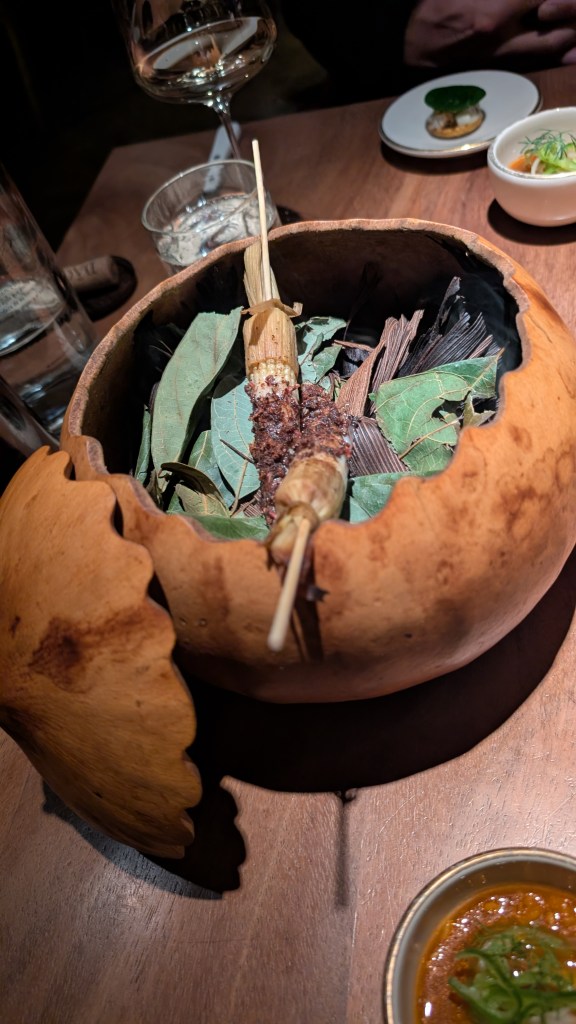
    The first dish arrived dramatically smoking. Just no way! The perfumed corn skewers coated in a chapuline and dark chili paste, served inside a cracked open gourd lined with dried corn husks and avocado leaves. The gourd sat on the table like an artifact. The corn inside it was at once completely ancient, this plant, this preparation, these insects , and completely intentional. Pujol does not invoke tradition. It inhabits it.
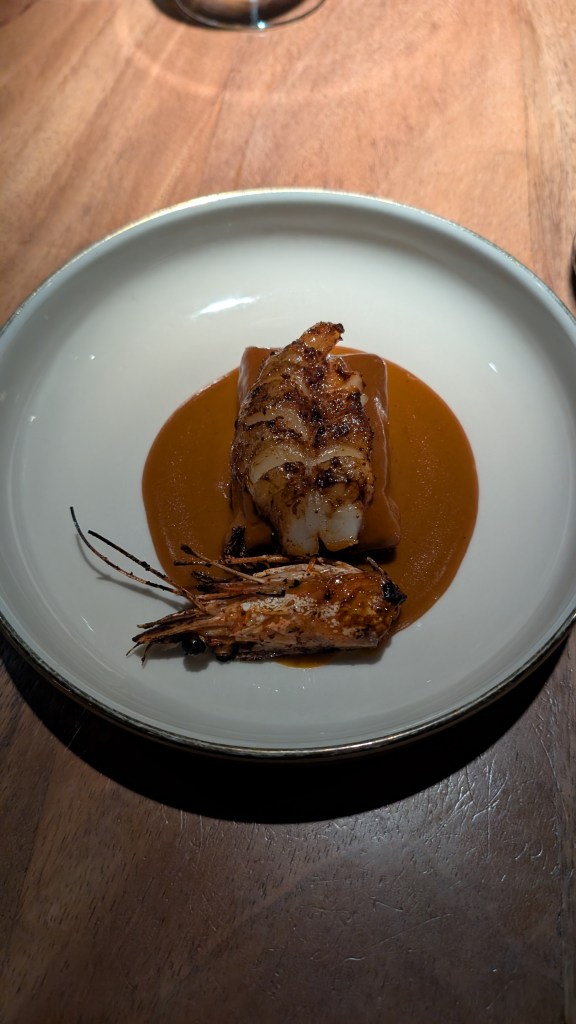
    What followed was a progression of controlled intensity: tostada, jewel-small, with cream and herb with raw sierra pristine and precise. A prawn in deep amber mole with a corn tamale under it. The prawn served whole, antennae intact, because at Pujol nothing is sanitized into comfort.
    Then the mole madre arrived.

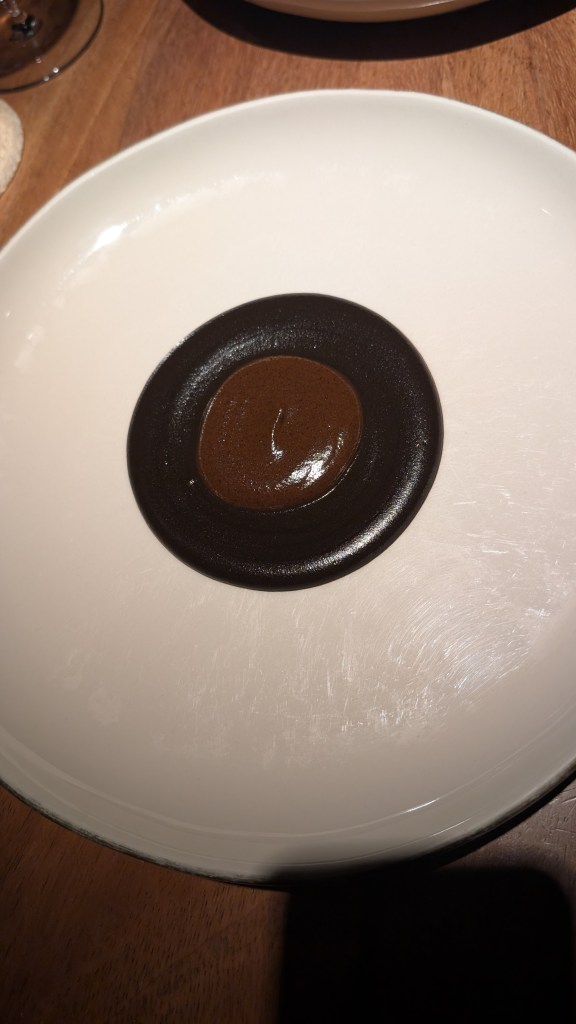
    It comes in a wide dish, white as a page: two concentric circles, the outer ring nearly black- the older mole, cooked without interruption for over a decade?- surrounding an inner pool of lighter brown, the newer preparation. No garnish. Just two beautiful corn tortillas. The dish is not asking to be eaten so much as contemplated. It is Pujol’s thesis and its credential simultaneously.
    The Niepoort white was done. So with it, a Chenin Blanc by the glass. The proper French terroir exhibited in a fifty dollar 5 ounce pour. The wine was luminous, honeyed at the edges, with enough acid to cut through ten years of accumulated complexity. Across the table, we were quiet in the way that good food and good wine occasionally make people quiet- not from lack of things to say, but from the recognition that the moment doesn’t need improving. The moment didn’t need improvement.

    Mexico is not a country in transition. What Mexico is doing, in its kitchens, in its vineyards, in its museums, in the quiet persistence of the man at the mercado who feeds people because he believes it matters, is an act of integration. The ancient is not being replaced by the modern. The modern is learning to speak the ancient’s language. The mole madre has been cooking for a decade. The new preparation poured into its center every day. Two ages of the same sauce, concentric, each informing the other.

    This is evolution through passion. Not the nihilistic destruction of what came before, but the patient insistence that what came before has not finished saying what it has to say. That is powerful sophisticated occurrence.

    Frida Kahlo painted her pain into permanence. Diego Rivera painted history onto the walls of a government building for anyone with eyes. The mezcalero in the mountains above Huatulco opens the same agave his grandfather opened, using the same fire, and produces something that tastes like the specific earth in which it was rooted. Todd and Ashley stood on a beach at sunset and made vows to each other in a landscape that has been doing what landscapes do, enduring, persisting, absorbing, for longer than any ceremony has a right to ask.

    Jennifer and John, somewhere in Washington state, are opening a Nebbiolo. And they rock! The mercado man is preparing tomorrow’s mole with love.

    It’s now August. The smoke from that shot glass in the mountains has long since cleared. What it left behind has not. It left behind something real. Dawn and I wanted to make something real out of this trip. And we did. We made Upstairs at Eric’s.
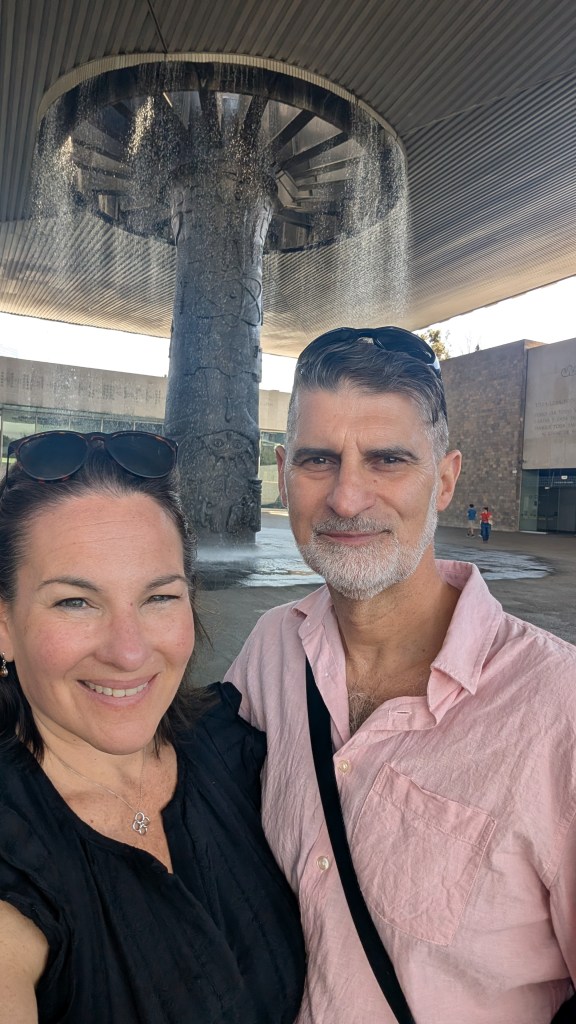
    Thank you Todd and Ashley.

    I love you Dawn.
  • Greenville’s Gen Z Wine Experiment

    The wine industry has spent the better part of a decade worrying about Gen Z.

    They don’t drink wine, we’re told. They drink hard seltzers. Canned cocktails. Sweet alcoholic beverages with flavors that sound more like a chemistry experiment than something found in nature.

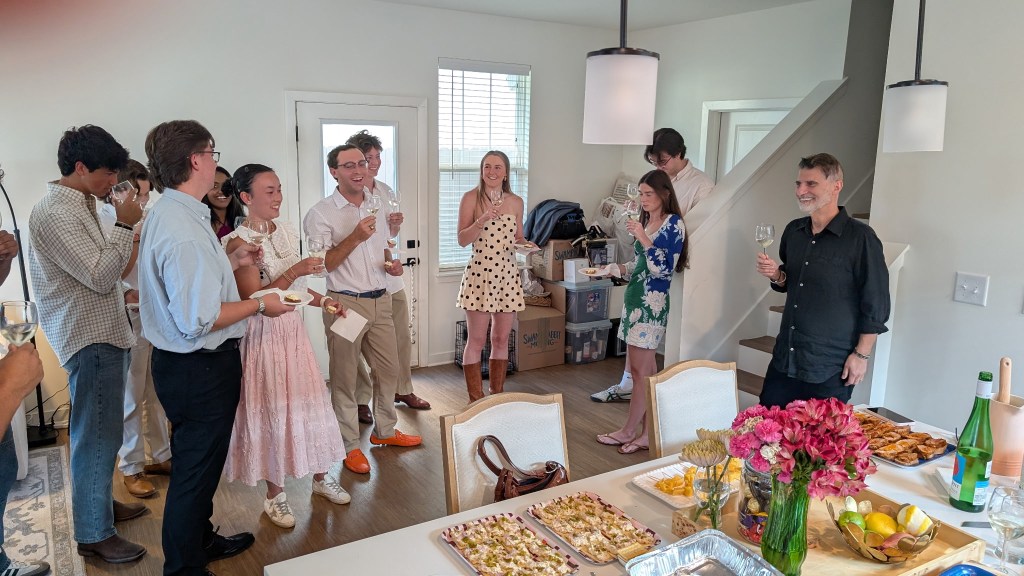
    Last weekend in Greenville, South Carolina, sixteen young adults between the ages of 21 and 23 demonstrated that the problem isn’t wine.

    The problem is that most people have never been introduced to it properly.

    The evening began not with a lecture but with a drink: a White Port Spritz from Portugal, tonic and fresh mint over white port. Light, refreshing, aromatic- close enough to the seltzer instinct that nobody felt like they were being lectured, but honest enough that it tasted like it came from somewhere. That was the whole idea in miniature: meet people where their palates already are, then show them there’s more on the other side.

    The tasting that followed was built around wines with personality, authenticity, and value. Not trophy wines. Not fruit bombs engineered to score points. Just honest bottles from places that have been making them for generations.

    A Vinho Verde from Portugal’s Minho region opened things up, paired with marinated goat cheese on sourdough-bright acidity against creamy texture, and people started paying attention. From there the pairings moved through a Picpoul de Pinet with smoked fish dip from Jones Oyster Co., a peppery Grüner Veltliner cutting through aged Gouda, and a Beaujolais Gamay that found an unlikely, delighted match in garlic prawns and chorizo.

    By the third or fourth pour, the questions had started.

    *Why does my tongue tingle on the sides?*

    *Why does this wine taste different after I take a bite?*

    *Why do I like this one more than the last one?*

    Nobody asked about critic scores. Nobody asked about brands. They asked about taste — which is, it turns out, exactly the education they’d never gotten.

    Three ingredients kept resurfacing all night, in the food and in the wines alike: lemon, basil, garlic. Nothing complicated, nothing fashionable- just quality left alone to express itself. It’s the same philosophy that made a Southern Rhône blend sing next to pork tenderloin crostini and harissa, and it’s the throughline the whole menu kept quietly returning to.

    Dinner brought the comfort-food turn- chicken parm on polenta cakes, prosciutto and mozzarella panini, meatball parm sliders — with a choice between Chianti Colli Senesi from Tuscany or an Oyster Bay Sauvignon Blanc from New Zealand. The choice itself was part of the lesson: different wines reward different palates, and there’s no wrong answer.

    Then the finale: a Five Puttonyos Tokaji from Hungary alongside panna cotta with mixed berries and pistachios. For most of the room, it was their first real sweet wine — and the reaction was the one it always is. Surprise. Most people have spent their lives being told sweet wine is unsophisticated. Tokaji, balanced by that much acidity and complexity, argues otherwise in about four seconds.

    The most encouraging moment happened the next day, when one of my son’s friends called him from a wine shop. She wasn’t buying her usual bottle of white Barefoot. She was looking for the wine she’d discovered at the tasting.

    She bought it.

    That single bottle told me more than any industry report on Gen Z and wine. Young adults don’t dislike wine. They dislike pretension, poor value, and being told what they’re supposed to enjoy.

    Give them wines with authenticity and a story behind them. Give them the opportunity to taste.

    The future of wine isn’t disappearing. It may simply be waiting for someone to pour the first glass.

    Neumod

  • The Douro’s Triangular Structure

    There are places that impress through excess.

    The Douro is not one of them.

    The Douro convinces through structure.

    Wine.

    Land.

    Food.

    Remove one, and the others lose their meaning.

    We left Porto immediately after landing from New York. No decompression. No buffer. The old train did the work for us. Metal, oil, age. It smelled like Europe before Europe decided to explain itself to visitors. There was something faintly unruly about it- like a relic from a time when movement still carried risk.

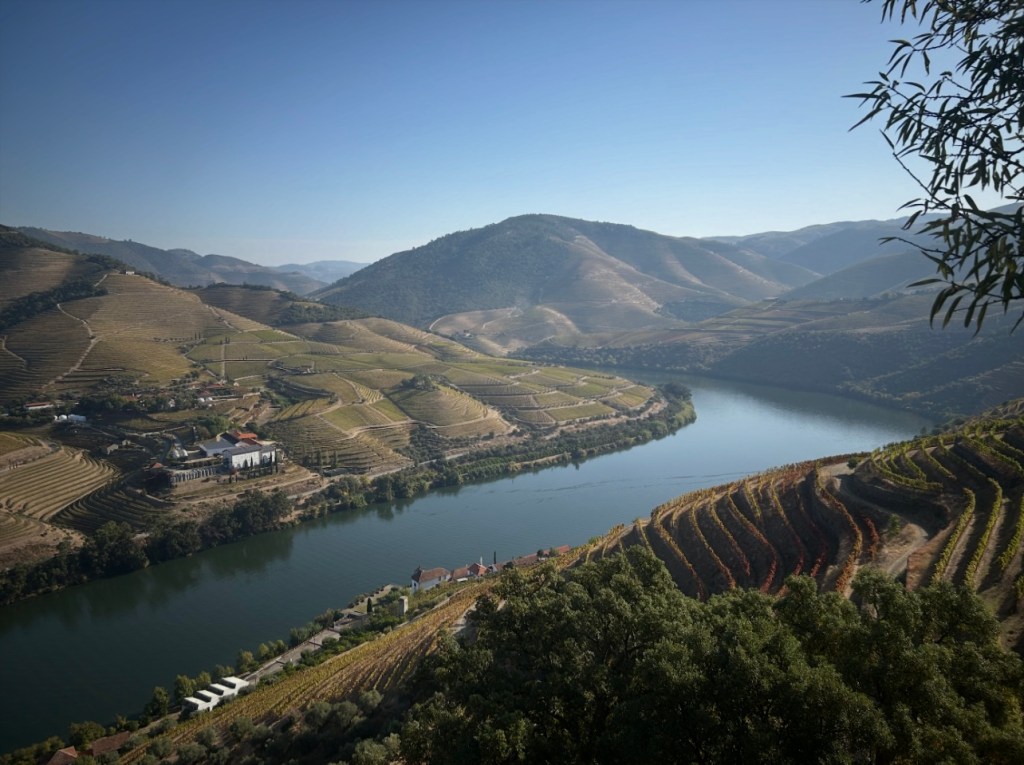
    Once the tracks began to follow the river, the valley revealed its logic. The Douro does not open theatrically. It asserts itself slowly, through repetition: slope after slope, terrace after terrace, schist exposed like bone. The river snakes not out of laziness, but necessity. Every curve feels load-bearing. Thrilling.

    Screenshot

    This is not scenery.

    It is infrastructure.

    Structure is a misunderstood word in wine.

    People confuse it with power. Or density. Or alcohol.

    They are wrong.

    Structure is composure under pressure.

    Tannins that hold without gripping.

    Acidity that lifts without cutting.

    Alcohol present, never leading.

    Fruit restrained enough to age, not perform.

    The Douro, at its best, understands this instinctively—because the land itself imposes it. Heat is real. Sun is relentless. Schist is unforgiving. Anything unbalanced here collapses quickly.

    We stayed at Quinta de São Luiz, perched above the river with the quiet authority of a place that doesn’t need to prove anything. Old vines. Vertical hills. Paths that punish laziness. Larry climbed to the peaks, the after the rest of us followed gravity downhill to the river’s edge and paid for it on the way back up.

    In the mornings and late afternoon, the infinity pool wasn’t indulgence- it was calibration. Cold water. Sharp light. No softness yet. Afternoons were earned.

    The first dinner mattered.

    Mackerel crudo.

    A dangerous dish if handled casually.

    Oil without salt is flab.

    Salt without acid is noise.

    This worked because the structure held: salt sharpened the fat, acidity lifted without puncturing, texture remained intact. Paired with a restrained Kopke white blend, low in alcohol and high in line, the dish stayed vertical. Nothing sagged.

    That’s when the trip revealed itself.

    Pinhão is touristy. It always will be. But geography doesn’t care about crowds. The river still frames the town. The slopes still dictate behavior.

    At Quinta do Bonfim, Pedro Lemos cooks with bilingual fluency-modern and traditional, without apology to either.

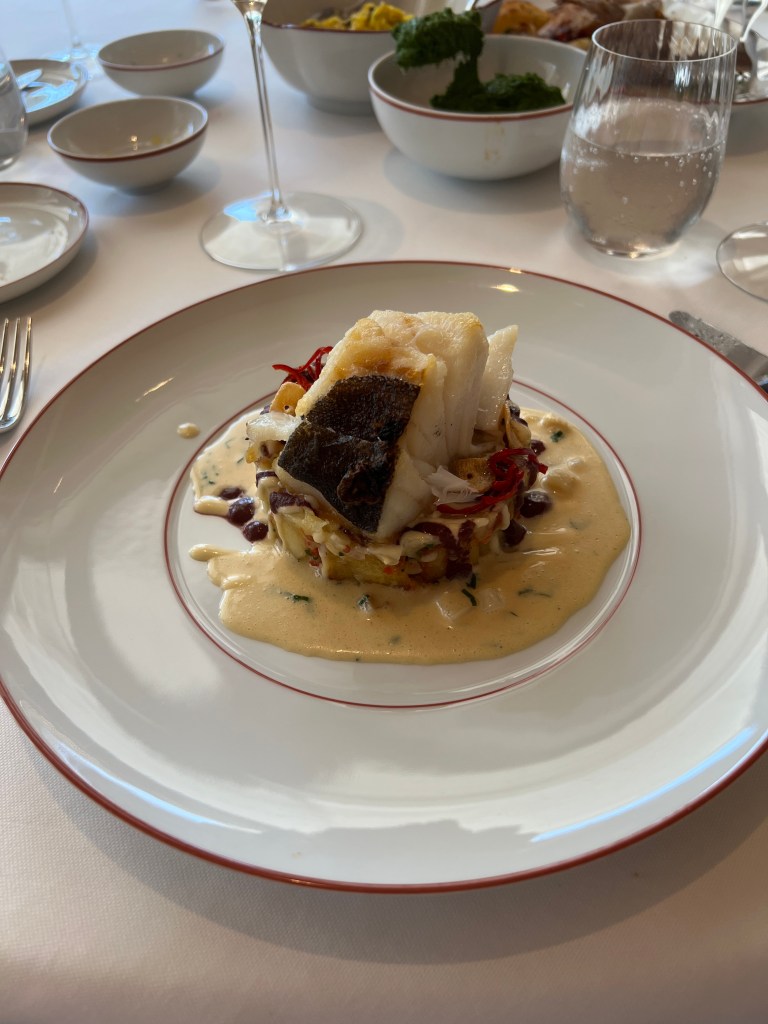
    Frank’s cod came first. Modern in approach, but disciplined. Flake separated from oil. Salt placed with intention. Acidity introduced surgically.

    I had the cabrito. No reinterpretation- I was surprised. The server spoke explicitly- No irony in the dish. Fire, time, fat, potatoes. The dish did exactly what it was supposed to do and nothing more. Amazing.

    The same wine carried both plates- Quinta do Vesuvio 2020- not because it was neutral, but because it was structured. Firm tannins. Controlled fruit. Alcohol integrated, not declared. This is the Douro when it resists theatrics.

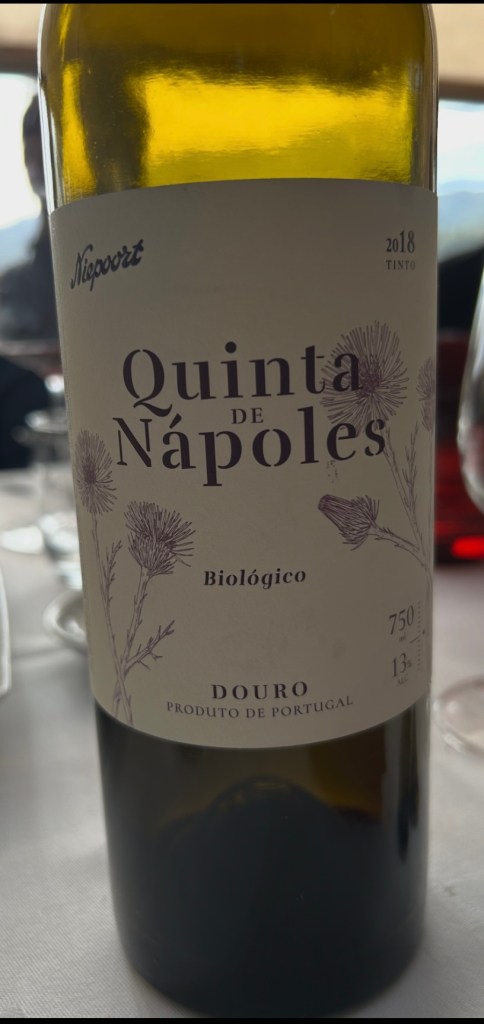
    At Quinta dos Nápoles, along a tributary away from spectacle, the conversation turned technical. Fermentation. Alcohol management. Organic farming not as ideology, but as control.

    Pedro, our host, didn’t flinch under detailed questions. Engineers ask differently. They look for stress points. The answers held.

    The food matched the philosophy.

    Farinheira that understood salt as foundation, not seasoning.

    A vegetable soup where sweetness never escaped discipline.

    Roasted baby lamb built on protein, fat, and patience.

    The 2018 Biológico stood out—not for weight, but restraint. Thirteen percent alcohol. Fine tannins. Acidity intact. This was finesse achieved by subtraction. A reminder that the Douro does not need excess to be serious.

    Screenshot

    Rui Paula’s DOC was the apex.

    Nine moments. Not courses—moments. Because structure isn’t linear; it’s relational.

    Raw gave way to cured.

    Cured to cooked.

    Fat followed by acid.

    Salinity by bitterness.

    Sweetness delayed until it could be controlled.

    Textures led. Flavors followed.

    Grouper with Horseradish and Lime Kaffir where gelatin met tension.

    The Crayfish Gaspacho with Melon built on salinity rather than garnish.

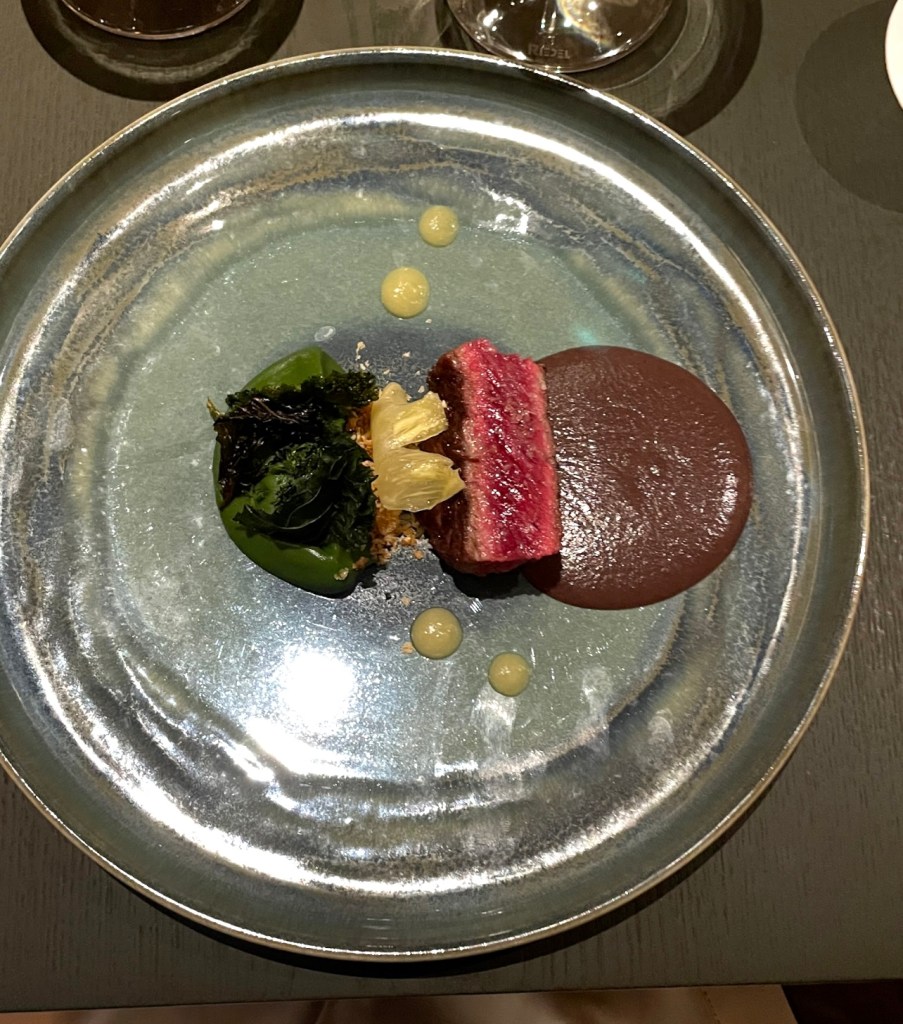
    Wagyu beef with Black Bean Sauce was reduced, not weighted.

    Screenshot

    And the Douro Boyz’s favorite dessert- Cauliflower Ice Cream with Olive Crumble and Citrus oil- structured around contrast, not sugar.

    Each wine framed rather than dominated. The most terroir intense wines were the SOL Alvarinho Quinta de Santiago & Mira do O, 2022 and Mirabilis Grande Reserva , Quinta Nova de Nossa Senhora, 2015. The Douro here acted as architecture, not decoration.

    The lesson was consistent.

    The Douro rewards discipline.

    It punishes indulgence.

    It remembers imbalance.

    Wine, land, and food here share the same demand: composure under pressure.

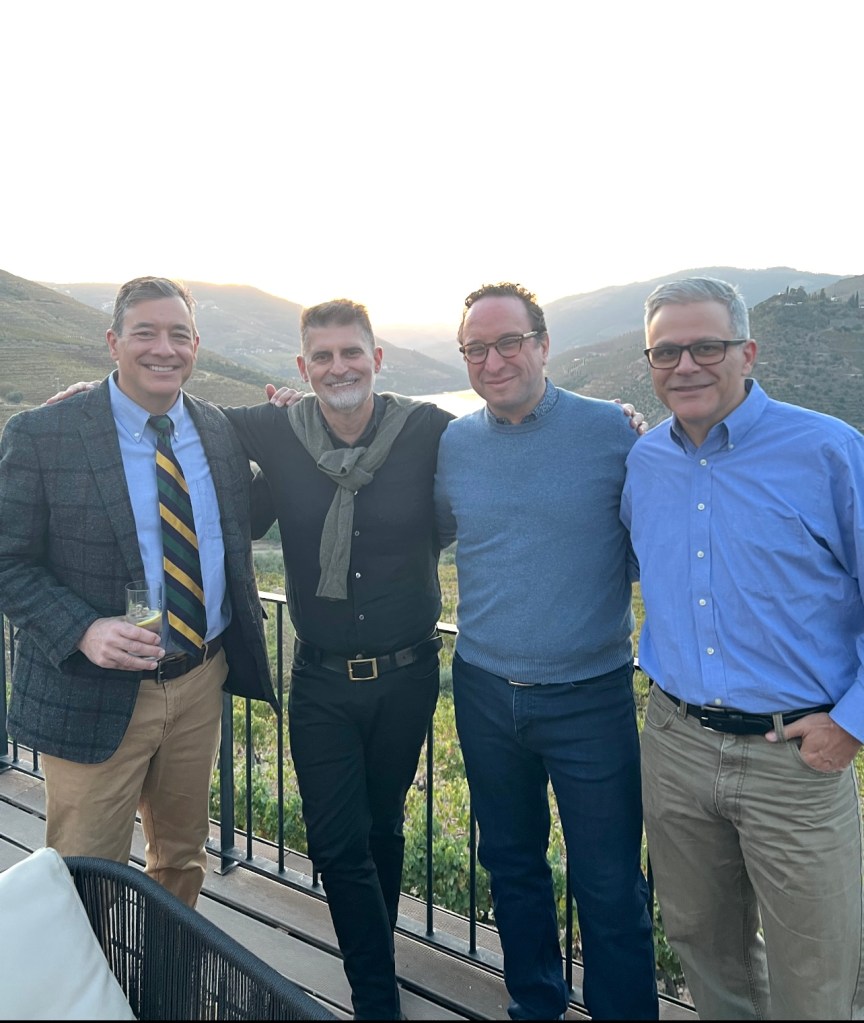
    The Douro Boyz- Larry, me, Frank and Hugo- didn’t just move upriver.

    We moved deeper into structure itself.

    And structure, once seen clearly, is impossible to forget.

    Screenshot

    Renato da Silva, NEUwine

  • Janitor of Fire: On Torre Mora Cauru 2022 and the Discipline of Volcanic Truth

    There are wines that behave like polite citizens: civil, well-mannered, eager to please. And then there are wines like Torre Mora Cauru 2022 Etna Rosso, which do not perform; they haunt.

    Cauru speaks in the same tone that Nico uses in “Janitor of Lunacy”—a tone scraped raw from grief, ritual, and self-reckoning. When Nico sings, “Careful of the moon, she’ll turn your mind around,” she could just as well be whispering from the basalt soils beneath Etna’s eastern flank, warning you that this wine is not here to flatter your palate. It is here to turn your mind around.

    Torre Mora’s Nerello Mascalese, touched by the ghost of Nerello Cappuccio, is forged on black volcanic sand- land that knows both birth and annihilation. The 2022 Cauru tastes like something rescued from the forge of a forgotten forge spirit:

    • Aromas: pomegranate skin, dried roses singed at the edges, embers of cedar
    • Palate: taut red currant, iron filings, cracked pepper and ashes
    • Texture: a mineral blade—no fat, no indulgence, only intention
    • Finish: long, spectral, slightly bitter, like the afterimage of a memory you should have released years ago

    Where other Etna Rosso wines chase prettiness, Cauru chases truth, which is always more dangerous- ask me about it!!! It stands in the glass like Nico stood on stage-intense, beautiful, unapologetic, severe, an emissary of some interior kingdom most people would rather not visit. Sublime.

    Shall we go back to “Janitor of Lunacy”? It is not a song. It is an incantation. Nico calls out the forces that distort us—false friends, false gods, false comforts—and demands a reckoning: “Take care of the beast… move him around.” The janitor she invokes is a custodian of disorder, a watcher of shadows, the one who forces the palace of illusion to collapse.

    Is this not precisely what volcanic wines do? They do not give you the polished, oaky promises of mainland aristocracy. They give you stone, scar, compression, eruption—the emotional register of a landscape always on the verge of tearing itself open.

    Cauru 2022 carries that same ritualistic stripping-down: no makeup, no ornaments, no choreography—just the pure timbre of origin, like Nico’s harmonium droning beneath the voice of someone who has seen too much and refuses to lie about it.

    Etna teaches discipline: it burns, it rebuilds, it remembers. Nerello Mascalese is its archivist. Nico teaches discipline: she removes the masks we cling to. Her voice is an austerity that reveals the architecture of our longing.

    Torre Mora Cauru 2022 and “Janitor of Lunacy” share the same structural backbone:

    • Minimalism as power
    • Restraint as revelation
    • Beauty found only after surrender
    • A dialogue between fragility and ferocity

    When you drink Cauru, you participate in a liturgy of volcanic truth.

    When you listen to Nico, you participate in a liturgy of emotional truth.

    Combine them, and the boundaries soften: the wine becomes the song’s mineral echo, the song becomes the wine’s psychological landscape.

    This is not a wine for the weekend hedonist. This is a wine for people who understand that beauty often arrives wearing the mask of severity—and that the mask is part of the message.

    Torre Mora Cauru 2022 will not hold your hand ( not a McCartney/ Lennon tune). It will not give you warmth without asking for introspection. It will walk with you into the dark corridor of your own palate, point at a door you’ve never opened, and whisper: “Go on.” Just like Nico.

    Drink it alone the first time.

    Not with friends.

    Not with dinner.

    Let the wine and the song confront each other inside you until the tension becomes revelation.

    Reni

  • Fitapreta: Wines for Those Who Still Believe in Miracles

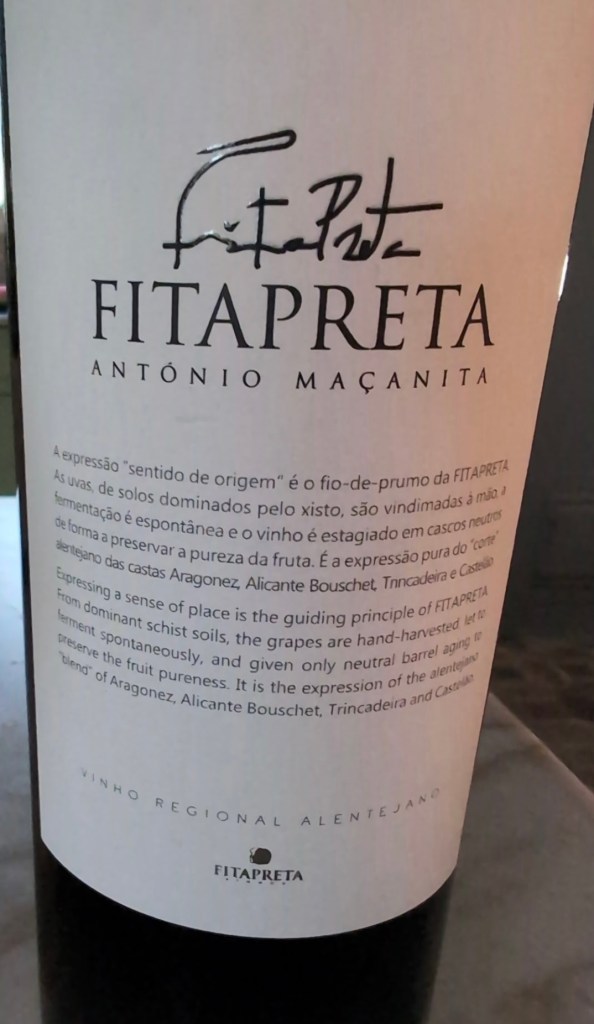
    António Maçanita doesn’t “make” wine so much as coax old stones into confession.

    His Alentejo parcels are relics of an empire- granite bones, schist scars- and he treats them like witnesses, not servants.

    No chemical gag orders, no heavy oak disguise. Just native grapes and the slow, un-coerced fermentation of memory.

    Below, four bottles that refuse to stay quiet.


    Os Paulistas 2021 – The Hermit’s Rebellion

    Vines once tended by monks now answer only to the night harvest.

    Tinta Carvalha, Castelão, Moreto—names the market nearly forgot- rise again in a field blend that tastes like a forest dreaming of fire.

    Cherry skin and wild strawberry spark first, then the deeper incense of leaf-mold and worn leather.

    Tannins whisper, acidity prowls.

    You drink it and sense the cloister door creak: history escaping, not returning. I am sure that Umberto Ecco owns a few cases of Os Paulistas.


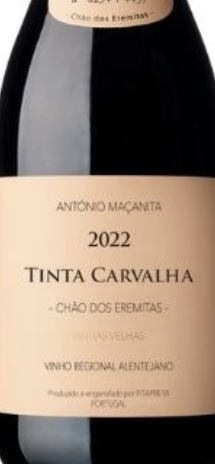
    Tinta Carvalha 2022 – The Ghost Grape

    Here’s Maçanita’s dare: a single, nearly extinct variety bottled like a headline.

    Pale ruby, light on the tongue, but sharpened by cranberry and pomegranate.

    Graphite flashes like struck flint.

    A wine that is as elegant as a Degas bailarina, that hums rather than shouts, showing Alentejo can be knife-edge fresh instead of furnace-heavy.

    Pair it with grilled sardines (yes!) or duck if you must, but it’s best alone, in the quiet argument between old and new Portugal.


    Indígenas 2022 – White Magic on Granite

    Arinto fermented by the yeasts that rode in on its own skin- a closed circuit of place.

    Citrus blossom, linden, a saline flick that smells of tide-pools after rain. Paradise.

    Texture like polished stone; acidity that draws a chalk line on the palate and dares you to cross.

    Serve it with shellfish if you’re polite, or just let it shatter the idea that Alentejo whites should be soft.


    Ilusionista 2023 – Sleight of Hand, Iron of Will

    Castelão, Aragonez, Moreto, Alicante Bouschet: a carnival of indigenous reds.

    The nose is all black plum, violet, a whiff of dry grass before lightning.

    On the tongue, it starts velvet and finishes with the grip of dark chocolate and council-floor debate- sweet talk followed by a motion to adjourn.

    Half aged in oak, half in steel, it balances opulence with a certain municipal Ebora Liberalitas Lulia discipline.

    A wine for long arguments and longer nights Roman style.


    All of these Fitapreta bottles are a rebuke to the international bland.

    These are not “market-ready” reds and whites; they are dispatches from an older Republic, a reminder that Portugal’s strength lies not in imitation but in remembering.

    Come for the tannins, stay for the existential clarity.

    Renato

  • A Tale of Three Cities

    It is a rare thing to measure life not in hours or days, but in moments plated and poured. Quality over quantity. Momentos.

    Portugal, with its stubborn sense of history and its reckless modern creativity, gave us exactly that. Three cities, three chefs, three tables, and an unbroken thread of joy that ran from the southern dried summer plains of the Alentejo through the azulejo hills of Lisbon and into the tough granite soul of Porto. Along the way, we toasted not only my wife Dawn’s birthday, beautiful and radiant as ever, but also my cousin Joana’s one-hundredth year. Imagine it: a century of life, celebrated alongside food so alive it defied the past.

    This was no ordinary trip. This was a tale of Évora, Lisboa, and Porto — three different stages, each with its own cuisine, its own wines, its own chorus of history and invention.


    Évora- Fitapreta Cozinha do Paço

    The first stage: Évora, sprawled across the Alentejo plains where light feels older, more golden, as if it has learned patience from the cork oaks. Here stands a 14th-century Morgado de Oliveira’s manor, lovingly restored by winemaker António Maçanita. The past has not been erased — it has been brought forward, dressed anew, the stones whispering of ancestors even as modern cuisine dances in the dining room.

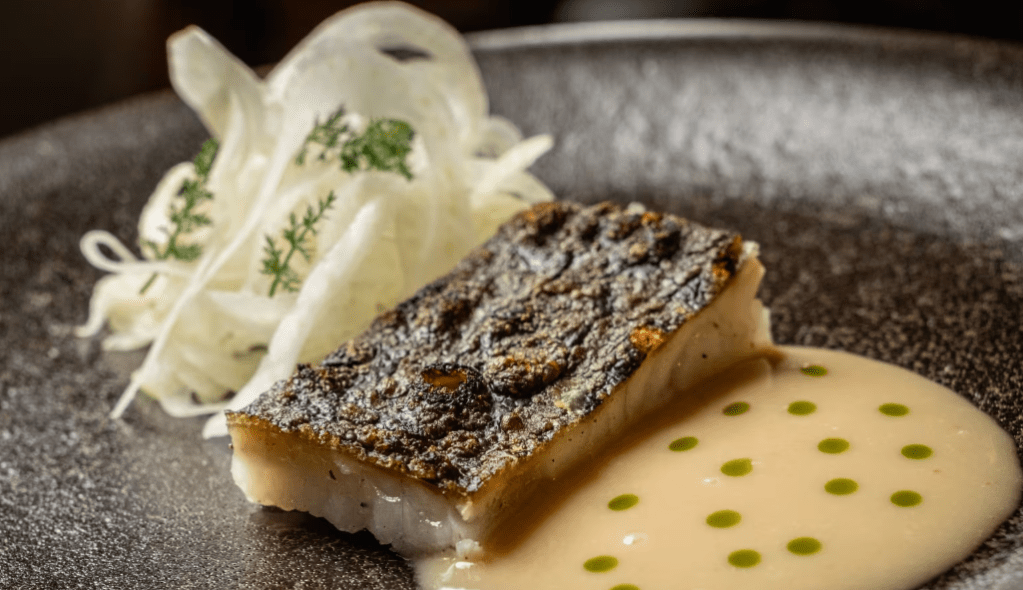
    Chef Afonso Dantas presides here, with the confidence of a man who knows his canvas is both ancient and daringly new. One dish captured it all: turbot fish in beurre blanc with shredded fennel salad. The turbot was velvet and sea-salt, a swimmer reborn in butter and acidity, while the fennel sliced through like a memory of anise on a hot day. It was as if the straw yellow Alentejo plains themselves had leaned in and whispered: “Yes, we can be delicate too.”

    The wine? Fitapreta’s Tinta Carvalha 2022. Rare and rebellious, this grape has been resurrected from near obscurity, much like the manor itself. The glass offered ripe raspberries and crushed cherries, laced with spice, floral whispers, even white tea. A licorice-tinged finish carried it all away. It was not just a pairing — it was a resurrection, proof that Portugal keeps the best parts of its past alive while reinventing the rest.

    Screenshot

    An honorable mention here must go to the tomato slice made of lamb with an egg yolk glaze. A trick of the eye, a sleight of hand: tomato as meat, meat as tomato, the yolk binding the illusion. We took the challenge. It was rich and intense. It was culinary mischief at its finest.

    And through it all, Dawn and I sat near a window in the hush of this historic manor, celebrating her birthday — romance layered atop history, butter layered atop turbot. A love story wrapped in stone walls and poured into beautifully produced long-stem wine glasses.


    Lisbon- Suba

    From Évora’s plains, we ascended into Lisbon, to the Palace of Santa Cataria in Bica, near Bairro Alto. History again, but this time filtered through minimalist renovation — heavy walls holding space for light. To me since I was a child, Lisbon is always a city of contradiction: steep streets, wide horizons; deep history, restless reinvention. Suba embodies this tension perfectly.

    Chef Fábio Alves orchestrates here with elegance and a wink. His dish called Exchange was nothing less than an argument in edible form: tuna laid against a Bolhão Pato flavored oyster foam, crowned with caviar, and grated dried tuna like sea-dust falling over the plate. It was bold as if Poseidon himself had created it.

    The wine was equally astonishing: Quinta de San Michelle Malvarinto de Janas 2022. A marriage of Arinto and Malvasia, it danced between sharp minerality and lush body. Notes of honeysuckle and white peach sang, while an herbaceous whisper grounded it. Together with the dish, it felt like Lisbon itself: sharp, lush, contradictory, and alive.

    An honorable mention here was our first momento- the Casa dish: alheira, codfish, and cornbread wafer, topped with a quail yolk and smoked in a glass box. It was a conjuring trick, a theatrical reminder that food is performance as much as sustenance. Frank and John were with us at this table. Family and friends bound by food, wine, and the city’s golden evening.

    If Évora had been romantic intimacy, Lisbon was social theater. We toasted friendship, invention, and the city’s refusal to stay still.


    Porto- Cozinha das Flores

    Finally, Porto. Granite and iron, river and salt. A city of merchants and poets, of Douro ports and Atlantic winds. Here, five minutes from the Douro itself, sits Cozinha das Flores, Chef Nuno Mendes’ temple of modern cooking. Unlike Évora’s manor or Lisbon’s palace, this is modernity with its sleeves rolled up — wood-fueled oven glowing at the center, a primal fire wrapped in sophistication. It reminded Dawn of Charleston’s F.I.G., but with a Portuguese accent, more fado than cool indie.

    The dish that defined it: Turnip Natas with Caviar. Creamy, earthy turnip folded into pastry, then adorned with the briny decadence of caviar. It was humble root meets high luxury, Portugal’s peasant soil shaking hands with its cosmopolitan future. A bite of paradox, perfectly balanced.

    The wine: Niepoort V.W. Bical and Maria Gomes Vinhas Velhas Branco Bairrada 2021. Pale yellow, sharp with acidity, yet rounded by candied citrus and verbena. Its saline finish was like seawater washing stones clean. Paired with the turnip natas, it was electric- soil and sea, root and brine, a reminder that Portugal thrives where opposites meet.

    Even the couvert here was unforgettable: sourdough, with the best churned butter I ever tasted, and an alheira dip mixed with a cured egg yolk. Simple, primal, but done with such devotion it felt like a benediction. Even the server called it “our beautiful couvert”. Dawn and I dined alone again here, the romance rekindled by modern firelight. Porto gave us resilience and refinement with its granite soul, and we answered with gratitude.


    Reflection-The Table as Time

    So what was this journey? Three cities, three chefs, three tables. But beneath it, one story: food and wine as time machines. In Évora, the past resurrected- that’s where Dawn and I got engaged in 1998. In Lisbon, the present performed. In Porto, the future ignited. “Is it past, or is it future?”, asked the man from another place in Twin Peaks.

    And alongside, two celebrations: Dawn’s birthday, radiant as a candle against the centuries; and Joana’s hundredth, a reminder that longevity is its own feast. Between them stretched friendship, love, family- the reasons we celebrate, eat, and drink.

    Portugal gave us more than meals. It gave us proof that life can be measured in turbot beurre blanc, in oyster foam and caviar, in turnip natas and saline wines. That memory can be held in a glass, that laughter can rise like smoke from a glass box, that history can be restored one manor, one palace, one oven at a time.

    It was, in the end, a tale of three cities — but also a tale of us, at the table, together.

  • Radical Structure: Grace Jones, Gigondas, and the Art of Reinvention

    There are covers. And then there are conquests.

    When Grace Jones released Warm Leatherette in 1980, she wasn’t paying tribute. She was declaring dominion. With surgical precision, she dismembered rock, punk, and soul standards, stripped them of sentiment, and reconstructed them in her own image: glacial, muscular, unapologetically angular. It wasn’t nostalgia—it was design. The production, helmed by Chris Blackwell and Alex Sadkin at Compass Point Studios, became a workshop in sonic geometry. And what emerged was something rare in music: a reinvention with structure and soul intact.

    This, too, is Gigondas.

    Often mistaken for a junior sibling to Châteauneuf-du-Pape, Gigondas is no tribute act. It is not a rustic echo nor a budget version. It is a revision—a rethink of what Southern Rhône wine can be when elevation, limestone, and deliberate structure take the wheel.


    Discipline, Not Decadence

    Châteauneuf-du-Pape has history, prestige, and the opulence to match. Like the original versions of Jones’ cover songs—from The Pretenders to Roxy Music—there is richness, elegance, and sometimes a touch of self-satisfaction. These wines are layered, baroque, and often sun-drenched to the point of excess.

    But Gigondas tightens the belt. It climbs higher. Its vines cling to the Dentelles de Montmirail like dancers suspended in tension. The result? A wine that trades opulence for edge—with firm tannins, bracing minerality, and a wildness Châteauneuf sometimes smooths away in polish.

    Likewise, Warm Leatherette trades the velveteen lushness of disco for the lean, dubbed-out rigor of reggae and post-punk. There is still rhythm. Still beauty. But it is hard-earned. Structured. Controlled.


    The Compass Point of the Rhône

    Listen closely to “Private Life.” What you hear is restraint weaponized. Sly and Robbie do not overplay; they undermine. Every empty space is deliberate. Every note a provocation. Grace doesn’t sing the song—she inhabits it with quiet authority. The production is immaculate not in its fullness, but in its balance. A masterclass in subtraction.

    Gigondas behaves the same way. Where Châteauneuf might drape itself in fourteen grape varieties and a robe of alcohol, Gigondas more often narrows the cast to Grenache, Syrah, and Mourvèdre, and lets the terrain dictate tone. Think black cherries under tension. Think rosemary and crushed rock. Think earth and steel held in suspense.

    This is not minimalism for fashion’s sake—it is structure with intent.


    Voice and Terroir: The Signature

    Grace Jones’ voice, like a Gigondas hillside, is elemental. Cold, regal, androgynous. You don’t listen to her for comfort. You listen for clarity, for authority. Likewise, you don’t drink Gigondas for plushness—you drink it for definition. For its verticality. For the way it commands attention without screaming.

    Jones redefined the song. Gigondas redefines the blend. Both are acts of authorship, not mimicry.


    Final Movement: On Not Playing It Safe

    In a world that too often rewards repetition and formula—whether in winemaking or pop music—Warm Leatherette and Gigondas remind us of a finer tradition: reinvention with backbone.

    Structure does not mean rigidity. It means freedom within form. It means letting terroir—or rhythm—speak without being drowned in overproduction or oak. It means respecting the original material not by preserving it, but by challenging it. Reworking it. Owning it.

    Grace Jones did not cover songs. She colonized* them.

    And Gigondas does not imitate Châteauneuf. It dismantles the hierarchy and builds something fiercer, higher, and less forgiving—but every bit as worthy.

    So next time you hear the bassline of “Private Life” roll in like distant thunder, or sip a Gigondas with its austere seduction and iron tannins—remember: some of the most lasting works of art come not from invention, but from the ruthless reinvention of what was once familiar.


    Footnote

    *On the Use of the Word “Colonize”

    When I say Grace Jones colonized the songs she covered, I mean it in the full, deliberate sense: she took control, imposed her own aesthetic regime, and rewrote the power structure of the original material. This is not a flippant metaphor. It is a statement about authorship, domination, and cultural inversion.

    Jones—a Black, Caribbean woman—entered a Euro-American songbook and didn’t just contribute. She seized the frame. Like a post-imperial mirror, she turned the logic of colonization back on the canon itself: occupying it, reshaping it, and radiating sovereign cool from its center.

    This is not a celebration of colonialism. It’s a reversal of it—and an acknowledgment that some revolutions in music and wine happen not through polite homage, but through forceful reinterpretation.

    Just as Gigondas refuses to kneel before Châteauneuf, Jones refuses to sing someone else’s song the way they intended it. She doesn’t ask for space. She takes it.

  • Popes, Punks, and Posers: What Your Wine Says About You

    In early America, hierarchy was brutally binary: you either owned land or you didn’t. Titles were gone, coats of arms discarded, and the powdered wigs left behind with the old world. In this raw new republic, land was the currency of power. If you had it, you were Somebody. If you didn’t, you worked for Somebody—willingly if you were lucky, forcibly if you were not. Race and gender? Let’s save that for a separate study—perhaps one paired with the opaque complexity of Nebbiolo.

    This wasn’t the old European social class system, with its centuries of codified manners and class-based choreography. America promised a clean slate—but let’s not kid ourselves: it simply replaced inherited privilege with economic absolutism. Karl Marx would’ve drawn a line down the page—haves vs. have-nots—and claimed he had captured the essence. No offense to Karl’s pedantic economic determinism, but today’s blog is about something far more nuanced—and perhaps far more delusional.

    Because what happens when those landless souls get a little money? They “climb”. And everyone cheers—Hallelujah, the American Dream lives! But the climb is economic, not cultural. You can buy the house, but you can’t buy the instincts. The lack of ease, the cultural dissonance—it shows. You’re out of sync, out of step, and you don’t even hear the music. And the tragedy? You don’t know it. You mistake consumption for sophistication. You think you’ve arrived, but what you’ve bought is the costume, not the character.

    But what if—what if—you embraced your place in the order? Not with shame, but with clarity. What if you didn’t pretend? Then comes liberation. You are no longer a confused social climber clutching your Châteauneuf du Pape with trembling hands. You are proud of your pint, your laced boots, your corner of the world. You’re not imitating the elite—you’re owning your own code. This is cultural class consciousness—not in the Marxist sense, but in the very real, very grounded awareness of who you are and who you’re not.

    And that, dear reader, is where the English Oi! movement makes its entrance. The cultural soundtrack of a working class that didn’t want to be invited to the gala. They brought their own beer. They weren’t interested in sophistication—they were interested in truth. No illusion. No pretense. Just combat boots on concrete and volume at 11.

    Now you’re probably wondering what the hell all this has to do with wine. Isn’t this a wine blog? Why are we talking about hierarchy and street punk music? Ah—but you see—that’s exactly the point. Wine, like music, like class, carries meaning. Some bottles wear their history like a velvet robe. Others show up with a twist cap and no apologies. And just like people, some wines know who they are—and some are desperately trying to be something they’re not.

    Let’s uncork that idea.

    The first time I heard the words Châteauneuf-du-Pape outside a wine afficionado’s mouth was in a Beastie Boys track. Yes, the Beasties. Body Movin’, to be precise. And in true New York City swagger, Ad-Rock spits:

    “Like a bottle of Châteauneuf-du-Pape / I am like a fine wine when I start to rap.”

    Now that—that—is cultural fluency. Ad-Rock didn’t say Merlot. He didn’t say Bordeaux. He went straight for the Southern Rhône’s aristocratic apex. Châteauneuf-du-Pape. The wine of popes. A bottle that doesn’t just taste rich—it signals it. And in one clever line, he placed himself in that hierarchy. Not by accident. With intention. Because if you know, you know. And if you don’t? You miss the reference, just like you miss the rhythm of a class culture that isn’t yours.

    So yes, this is a wine blog. But it’s also a meditation on how we perform identity. Through music. Through what we drink. Through how we pretend—and how we sometimes, beautifully, don’t.

    Let’s begin where the vines grow thick with history: Southern Rhône.

    Châteauneuf-du-Pape literally means “the pope’s new castle.” In the 14th century, during the Avignon Papacy, the puppet Pope Clement V established residence in Avignon, leaving the Vatican behind, and had an appetite for great wine besides an appetite for the destruction of the Knights Templar.

    To this day, Châteauneuf-du-Pape bottles bear a papal seal etched into the glass—a literal mark of sanctioned quality. This wine knows it is on top. It was born into it. And like old money, it doesn’t shout—it assumes you already know.

    Compare that to Côtes du Rhône. A wide appellation with wine that’s often affordable, drinkable, and unpretentious. It’s not worse—it’s just not trying to impress your sommelier cousin at Thanksgiving. It’s the garage band to Châteauneuf’s cathedral choir. It does the job and gets you happy. But it’ll never be name-checked by a rapper—unless irony is involved.

    Now back to class consciousness. Enter Oi!—a raw, loud, unapologetically working-class genre that emerged from the industrial heart of England in the late 1970s. It wasn’t interested in the pomp of prog rock or the pretension of art school punk- right Colin Newman? Oi! was boots, pubs, and shouting back at a system that never listened. It didn’t want to be accepted by elites. It reveled in being dismissed. Just like a $9 bottle of Côtes du Rhône with a screw cap that still pairs perfectly with sausage and vinyl.

    In contrast to America’s illusion of class mobility—the “if you make enough money, you’re classy now” delusion—Oi! never wanted to climb the social ladder. It pissed on the rungs. It lived, drank, and shouted in its own space. And that is the entire point: cultural confidence isn’t about climbing. It’s about claiming.

    So what does it mean when you buy a bottle of Châteauneuf-du-Pape? You’re not just buying wine. You’re buying into a legacy, a narrative. You are, even if just for a night, participating in a pageant of aristocracy—papal robes replaced by linen napkins and stemmed glasses.

    And what does it mean when you unapologetically drink a humble but great Côtes du Rhône on a Tuesday with pizza and watch reruns? That maybe you’re more self-aware than the guy swirling Burgundy while talking about “terroir.” Maybe you don’t need the seal, the prestige, the pope.

    So Kyle, you asked why another wine blog? Because this isn’t just about wine. It’s about stories, symbols, and the delusions we drink with our Merlot. It’s about knowing when to pour the Pape and when to pop the proletariat red with pride.

    Wine doesn’t lie. But we do—to ourselves. And sometimes, we need a little Châteauneuf clarity or Oi! honesty to break the spell.

    Here’s to knowing who you are—whether you’re wearing a cassock or a Fred Perry shirt.

  • To Glass or not to glass?

    Willy’s place outside Girona is a shrine to one thing and one thing only: Bordeaux stored in glass. Thick bottles, deep punts, proper corks—stuff that feels like it should come with a Latin mass and a choir. Willy pours, he drinks, he smiles. Ask for tasting notes and he waves you off like you just suggested adding ice cubes. “It’s good. Next question.” End of seminar. You like that attitude, don’t you?

    Step outside Casa Willy and real life smacks you—mortgage/rent, traffic, and supermarket end-caps stacked with wine dressed up as juice boxes. Yes, apparently we now drink from cardboard bladders and aluminum soda cans. Because nothing screams haute viticulture like ripping a foil pouch and squeezing out three liters of mystery red next to the dishwasher.

    The evangelists have their talking points: cheaper, lighter, greener! Great—so is tap water. Bag-in-box “keeps fresh for a month,” they say. Translation: the wine was so forgettable you needed 30 days to finish it. Cans are “perfect for the beach.” True—because when the tide rolls in, nobody can taste that your rosé came pre-carbonated with a hint of aluminum rim.

    Look, I’m not blind. Ninety-something percent of wine is guzzled within the week. Most of it never needed ageing, never deserved glass, and probably tastes the same pouring from a Lands End rain boot. But a bottle still does two magical things the box brigade can’t touch: it lets a wine grow up and it tells you the maker cared enough to dress the liquid properly. A cork is a promise; a pull-tab is a shrug.

    And spare me the sustainability sermon. You want to save the planet? Skip a flight to Ibiza, plant a tree, ride a bike. Don’t ask me to celebrate Nebbiolo in a Capri-Sun pouch as ecological heroism. See what you did Tom?

    So here’s the math:

    • Collectible, age-worthy wine: needs glass, period.
    • Everyday plonk: sure, shove it in a milk carton if you must. Just don’t pretend it’s a revolution.
    • Box and can drinkers: congratulations—you’ve traded ritual for convenience. Enjoy your adult juice box; I’ll keep my corkscrew and my leather bottle bitch bag.

    Willy will keep swirling his Chateau Margaux, Chateau Haut- Brion, and Chateau Lafleur, secure in his slightly dusty temple of glass. I’ll stand beside him, sarcasm ready, watching the cardboard crusade march past like a discount parade. When the cork pops, we’ll toast to real bottles—and raise a gracious second toast to everyone else, sipping their Pinot from metal tubes, convinced they’ve hacked wine.

    Because in the end wine is supposed to taste good. A bottle guarantees at least the possibility of greatness. A box guarantees…a handle. Choose wisely.

    Thanks Tom and Tripp.

  • Wine as Empire: Camões and the Ferment of Fitapreta

    To drink Fitapreta is to drink with ghosts—the kind that do not haunt, but command. In each glass, António Maçanita has trapped the same fury that Luís de Camões once bound into verse. This is not wine for the docile or the merely curious. This is wine for the discontented, for those who feel in their marrow what Camões wrote of the Portuguese spirit: “Dai-me uma fúria grande e sonorosa” (“Give me a great and sonorous fury,” Canto I, 4). Fitapreta is not designed to comfort—it’s designed to summon. And what it summons is a memory: of empire, of defiance, of men who walked toward the edge of the known world with their backs straight and their fates unrepentant.

    Risk is the wine’s blood. Camões consecrated risk as the original virtue of the Portuguese: “Ó fortes, que por obras valerosas / Se vão da lei da Morte libertando” (“O brave men, whose valorous deeds / Free them from the law of Death,” Canto I, 2). Maçanita’s viticultural decisions mirror that ethos. Who else has the audacity to farm abandoned varietals in Alentejo’s punishing heat, to vinify wines with minimal intervention in a market addicted to polish and predictability? To make Fitapreta is to stand at the prow of one’s own fleet, daring the storm to strike. It is a practice not of safety, but of sovereignty.

    Adventure, in Camões’ telling, is both sublime and perilous—a dance with fate under black sails. The poet’s Adamastor does not merely threaten death; he incarnates it: “E eu sou aquele oculto e grande Cabo / A quem chamais vós outros Tormentório” (“I am that hidden and mighty Cape / Which you call Tormentor,” Canto V, 39). Maçanita’s wines speak in the same register. They resist easy drinking. They announce themselves with tension, with spice, with wild mineral veins that cut across the palate like rigging in a gale. Fitapreta is no perfumed token of terroir—it is a navigational act, a wine that demands direction and dares the drinker to take the helm.

    Assertiveness here is not swagger—it is the quiet certainty of purpose. When Camões invokes Portugal’s right to glory, it is not meek: “Cessem do sábio Grego e do Troiano / As navegações grandes que fizeram” (“Let the voyages of the Greek and Trojan sages / Cease to be praised,” Canto I, 3). The poet replaces Homeric antiquity with Portuguese modernity, just as Maçanita replaces tired oenological mimicry with native command. Fitapreta does not apologize for being Portuguese. It asserts that to be Alentejano is not to be lesser—it is to be elemental. Granite, heat, tension, structure—this is a wine that knows what it is, and says so without blinking.

    Grit, finally, is the muscle beneath it all. Camões knew hardship intimately—wounded in Ceuta, shipwrecked near Cambodia, begging in the streets of Lisbon. Yet even from ruin, he composed the epic of a nation: “E entre gente remota edificaram / Novo Reino, que tanto sublimaram” (“And among distant peoples they established / A new kingdom, which they so greatly exalted,” Canto I, 20). Likewise, Maçanita doesn’t craft his wines from privilege, but from pressure—economic, climatic, cultural. Alentejo is a land of struggle, and Fitapreta bears its scars like medals. This is not a wine made to charm. It is a wine made to last.

    Camões gave Portugal its voice; Maçanita distills that voice into matter. In Fitapreta, we taste the persistence of a myth, reforged in iron and blackberry, in salt and sun. This wine does not simply tell a story—it continues one. A story of men who defy, who wander, who endure. A story that Camões began with a quill—and that Maçanita now continues, bottle by bottle, like a cannon shot across time.

    Screenshot