It has been six months since our trip to Mexico.
Oaxaca
A mezcalero deep in the mountains above Huatulco hands us a shot glass. The liquid inside has been infused with local flora: herbs and roots whose names we won’t remember but whose effect we will. This is not a tasting. This is an introduction. Mexico does not offer itself gradually. It opens all at once, from the inside out, and asks whether we were ready for it.
We came for a wedding. Todd and Ashley chose this coast because some places do not merely host a ceremony-they make it real. The reception was set on the beach. The Huatulco Pacific waters absorbed the music. The hills absorbed the light. The vows that were made that evening, the landscape bore witness and the landscape is ancient. It does not forget.
But Dawn and I planned to extend our trip to Mexico with another mission: to experience Mexico’s art- especially its gastronomy and wine.
On our first dining out experience we found ourselves sharing a table with Jennifer, Ashley’s cousin, and John from Washington state. These things happen when you travel with intention- you find the people who travel the same way. Within ten minutes we were sharing our love for Nebbiolo. There was a Mexican Nebbiolo on the menu. But it was unrecognizable. If you had given me a blind taste test, I would have said, “shit- a big ass wine from California like a Pinot Noir blended with Syrah or Zinfandel?” Totally rude but, talking about terroir! I am glad I was not the only one who didn’t like the wine. Phew! We moved on to experience other wines. The Monte Xanic Chenin Blanc & Colombard from Valle De Guadalupe Baja was harmonious in aroma, taste and body and offered some acidity despite its ripeness. Together, it danced beautifully in our mouths with the rich grilled grouper in a mole and lemon butter sauce.
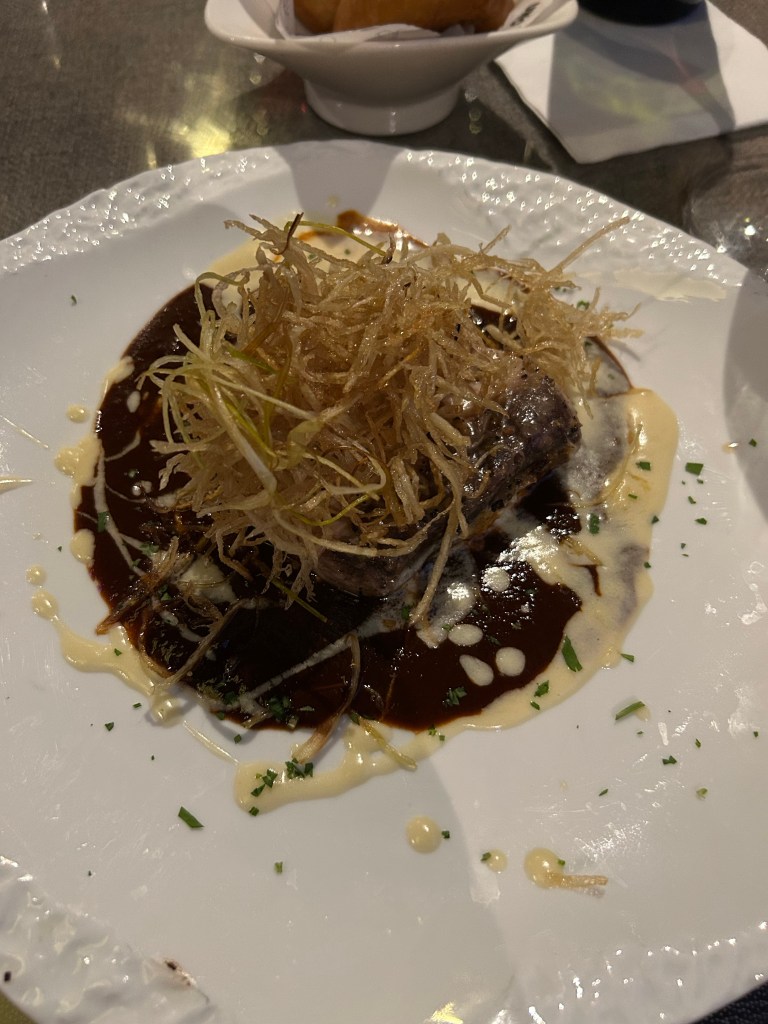
The food in Oaxaca does not ask for your opinion. It asks for your attention. At the restaurant Aroma where we dined and around town, the mole tradition revealed itself in layers: not as a single preparation but as a philosophy. Mole negro is built on cacao, dried chiles, charred tomato, and time. It is simultaneously ancient and alive, and when it appears on a plate under braised meat with a garnish of crispy leek, it has not become something else. It has become more fully itself.
The next day, we stopped at the local mercado. Oaxacan markets operate on a different frequency from tourist commerce. Lots of merchandise everywhere- shirts, statues, souvenirs. But the dried chiles hung in curtains got my attention as did the mole pastes in terracotta jars. The air tasted of chocolate and woodsmoke and something older than either.
It was at a family-run eatery inside the mercado that we met a man whose name we never caught but whose presence stayed. He ran the operation with the quiet authority of someone who has always understood that feeding people is a form of love. He brought us chilichilles verdes and grilled steak in mole. The mole was thinner than Aroma’s, but equally complex. And then he sat with us, talked softly, in the way, that only people who have no reason to perform hospitality actually do.
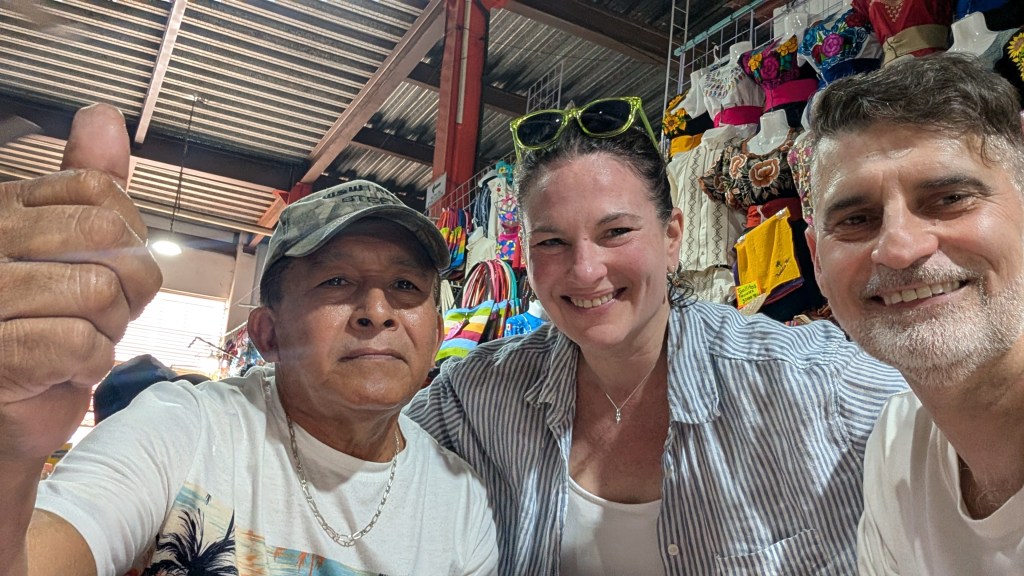
By Monday morning, when we sat down to the wedding brunch and said goodbye to the coast, Oaxaca had made us feel that we had been experiencing something real. LCD Soundsystem’s James Murphy sang in Losing My Edge “you want to make something real…you want to make a Yaz record”. Yeah, we were making a Yaz record.
Mexico City is three hours by air from Huatulco and approximately five centuries in sensibility. You leave a coast that operates on biological time- tides, harvests, the slow fermentation of agave in clay pots, and arrive in a metropolis of twenty-two million people that has been building, tearing down, and rebuilding itself since before the Spanish arrived to destroy it the first time. The city does not reconcile its contradictions. It wears them.
Mexico City
We stayed at Casa Decu in the Colonia Condesa. Art Deco buildings, jacaranda trees over wide sidewalks, restaurants whose menus read as arguments about what Mexican cuisine has the right to become. We were ready to continue our mission.
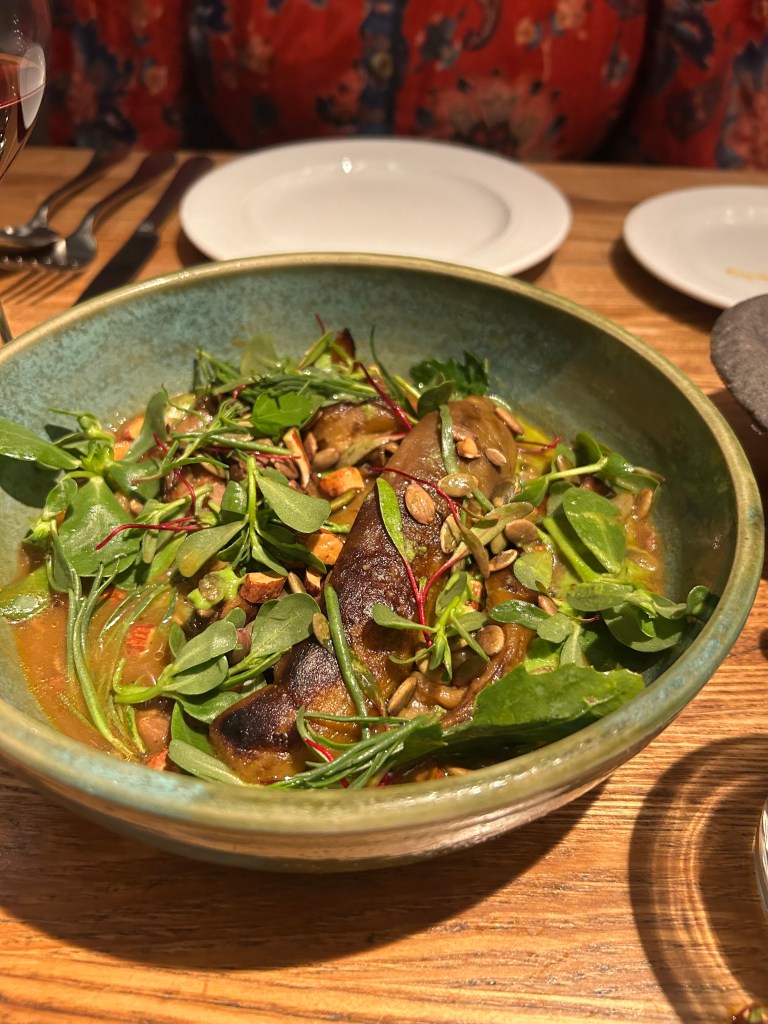
Our first dinner was at Merotoro. Our waiter was new and appeared nervous. We ordered a Vena Cava Big Blend 2021 from Valle de Guadalupe in Baja. This big wine, ended up being way too big for the dishes we ordered. Made from Tempranillo, Cabernet, and Syrah, it needed an aged Texas ribeye steak rather than the delicate beef stew with fresh greens that we had. Reflecting back, I believe that we were also as nervous as our waiter with our first CDMX restaurant.
Day two in the capital began in a chaotic manner with some transportation miss-happenings. Eventually, we made it to Coyoacán. This neighborhood does not belong to the same temporal register as the rest of CDMX. It is cobblestoned, leafy, self-aware. Diego Rivera and Frida Kahlo lived here. Leon Trotsky “got an ice-pick that made his ears burn” as Hugh Cornwell so bluntly spew in No More Heroes. History in Mexico does not stay in the past. It keeps appointments.
The Museo Frida Kahlo, La Casa Azul, is one of the most intimate famous place I have ever been. The yellow shelves holding Talavera pottery. The folk masks watching from the walls. The still life paintings that are not merely still but accumulated the evidence of a life so interior it could only find expression in color. The draped stone figures glimpsed through iron gates in the courtyard, half-visible, suggest restoration or concealment, and somehow this feels correct. Frida Kahlo spent her entire life in the process of being uncovered. Two hours inside that house and you understand that her art was not a response to her pain. Her art was the structure she built to contain it. The pain was the material. The passion was the architecture.
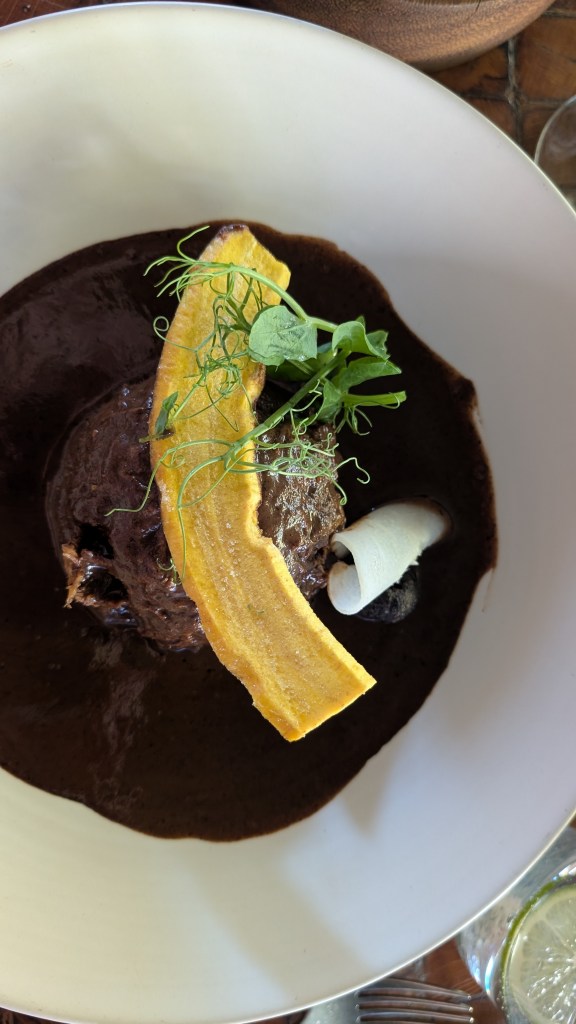
We walked out into the Coyoacán afternoon and sat down to lunch at Los Danzantes, where the food is rooted in traditional Mexican technique and the execution is contemporary without apology. We both knew that this week was building toward something special in terms of food and art. But holy mole! (yeah cheesy but I can’t help it). The multicolored tortillas, the short rib pulled meat in mole was perfect with the Monte Xanic 2024- Rose and Sauvignon Blanc.
The next morning we followed Rivera’s murals at the Secretaría de Educación Pública, wall after wall, room after room of painted argument, the history of Mexico told not as a procession of dates but as a confrontation between labor and power, between indigenous memory and colonial amnesia. Brilliant. Rivera painted with the confidence of a man who believed painting could change things. He was right about the painting. He was optimistic about the things.
After a 4.4 earthquake on the Richter’s scale,we lunched at Balcón del Zócalo, on a rooftop terrace overlooking the historic center. The Palacio de Bellas Artes rose to the west. The Cathedral and the Templo Mayor held their ground below. There is something about eating and drinking above a city that has survived conquest, earthquake, revolution, and the slow violence of modernity: it makes the glass in your hand feel like a comment. I photographed mine: a Mexican orange wine- Bichi La Gorda Yori- a Chenin Blanc based wine fermented in concrete amphorae with skin contact. Amber and opaque, and in the curved surface of the Riedel glass, the towers of the Bellas Artes were reflected upside down and perfectly intact. It was perfect. The ancient city caught inside a fermentation that didn’t exist here five hundred years ago and now does with complete conviction.
An then there was food. They brought bread first. Two kinds. A white roll, open-crumbed and honest. And a sourdough made with cacao, dark all the way through, served with a quenelle of cacao butter on a small stone tile. The bread was not a gesture. It was a thesis statement. Cacao in Mesoamerica predates every other use to which the world has subsequently put it. To bake it into bread and serve it as the opening act of a meal that will close with mole negro is to arrange the whole history of the ingredient into a single sitting.
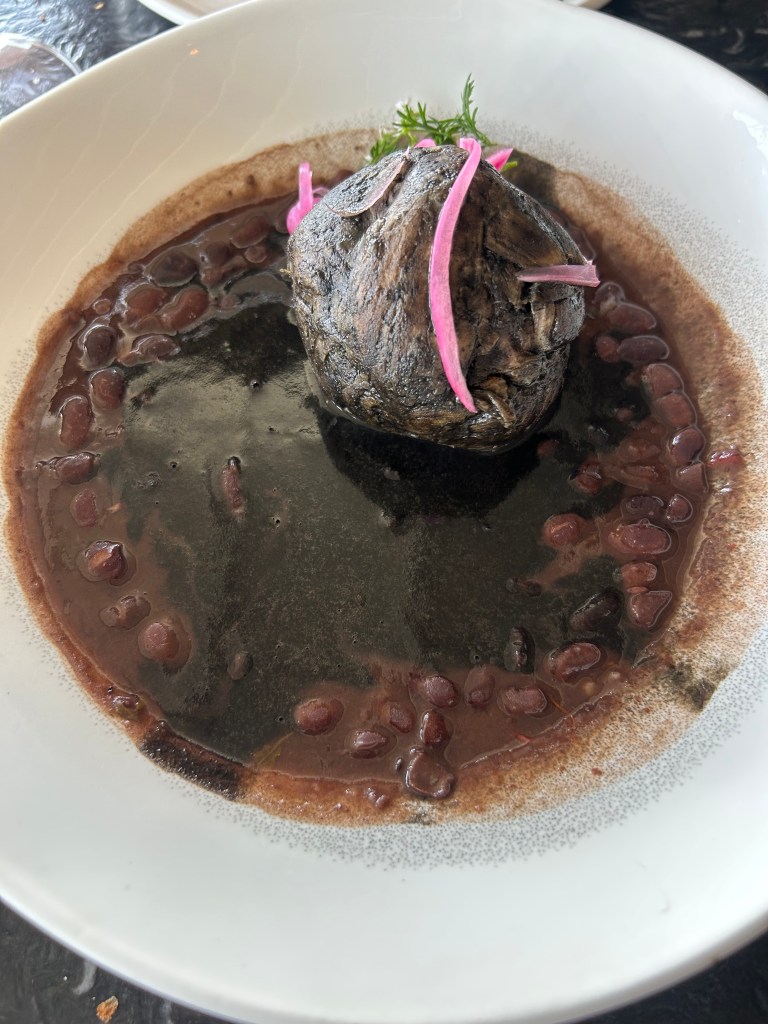
The mole negro arrived later around a whole braised mass of pork shoulder, sitting in a bowl of black bean broth scattered with whole beans, a streak of pickled pink onion on top, a sprig of dill. After the Casa Azul’s riot of color, it felt like the city exhaling. With the mole I drank the orange Chenin Blanc while Dawn had a glass of Hacienda Encinillas, a Bordeaux blend from Chihuahua, of all places, from an estate whose colonial roots stretch back centuries and whose altitude gives its reds a structure the heat alone wouldn’t suggest. Two glasses. Two arguments about what Mexican wine is becoming. And now, exciding expectations!
Cuisine and social stratification
I am sure there are plenty of articles about the dichotomy in gastronomy. So let’s add to such a lens. Pujol is in Polanco. If you know Mexico City, that sentence is already doing its work. Polanco is the neighborhood that tells you exactly what it is before you have sat down: the addresses, the architecture, the particular quality of the silence between one luxury and the next. Enrique Olvera opened his restaurant here and in doing so made a statement about where serious Mexican gastronomy would position itself- not in apology, not in nostalgia, but in full confrontation with the international dining world, on its own terms, using its own materials.
The room is warm, dark-wooded, attentive without being deferential. If I had not been aware of Foucault’s influence in imperialist discourse analysis, I would easily have said it was so Napa-esque. But I will not say it. We were barely seated when the wine director told us that there was no wine pairing with today’s chef menu. I almost exploded. His simple explanation was that the menu was based on the chef’s roots in Oaxaca. He left me wondering if that was too much of a complex task to pair their insane cellar wines with the various dishes. Instead, he offered to curate a pairing experience based on the available wines by the glass. No thank you. As fast as I could, I flipped through what appeared to be thousand of pages in their ridiculous wine menu. I looked for a Mexican white wine first. The ones available weren’t known to my palate. And with a price tag over $150, I didn’t want to take a chance. I noticed a Dirk Nieeport Douro white wine on the menu. Bingo! A white that found its way across the Atlantic and onto this list for good reason: the grape’s mineral tension and textural weight moved through most of the courses with the confidence of a wine that knows what food tastes like. Dirk Niepoort’s wines carry the obsessive logic of someone who has spent a life refusing the easier path. They were appropriate company.
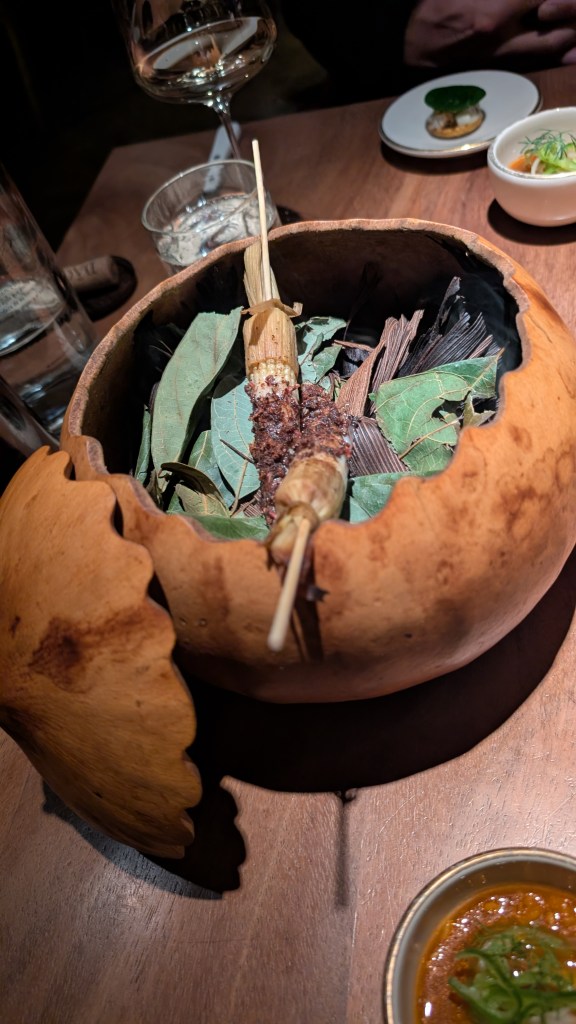
The first dish arrived dramatically smoking. Just no way! The perfumed corn skewers coated in a chapuline and dark chili paste, served inside a cracked open gourd lined with dried corn husks and avocado leaves. The gourd sat on the table like an artifact. The corn inside it was at once completely ancient, this plant, this preparation, these insects , and completely intentional. Pujol does not invoke tradition. It inhabits it.
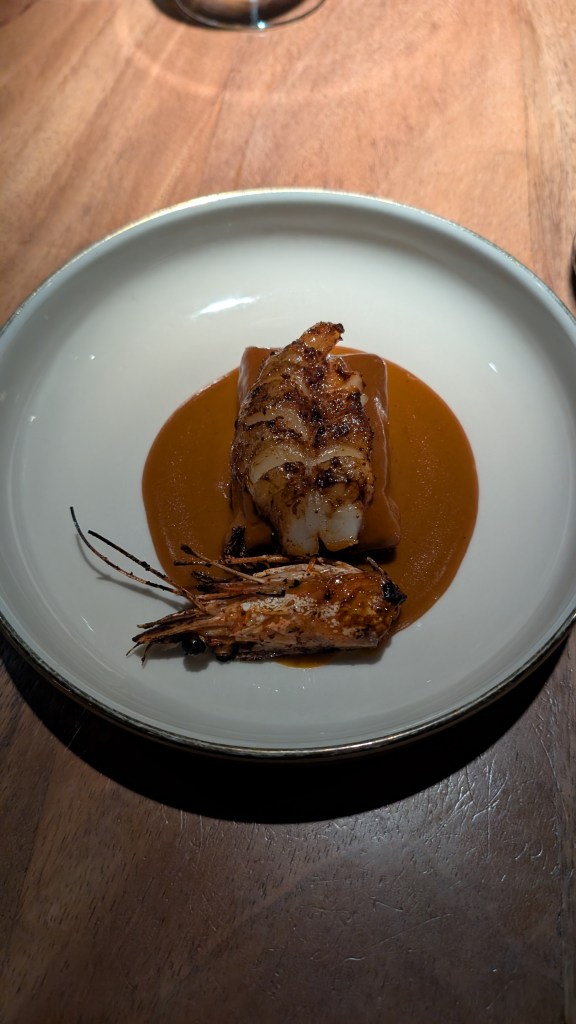
What followed was a progression of controlled intensity: tostada, jewel-small, with cream and herb with raw sierra pristine and precise. A prawn in deep amber mole with a corn tamale under it. The prawn served whole, antennae intact, because at Pujol nothing is sanitized into comfort.
Then the mole madre arrived.
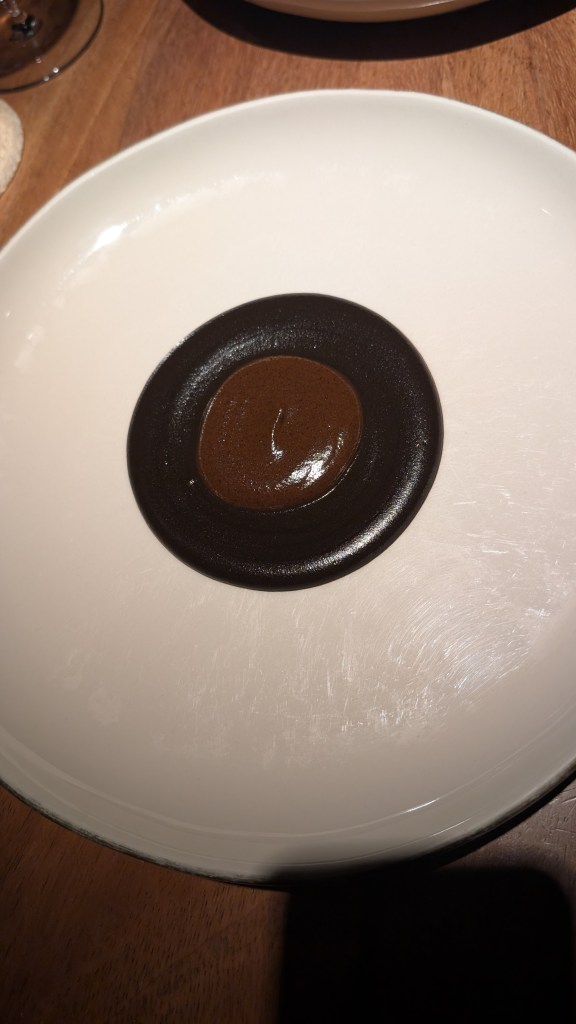
It comes in a wide dish, white as a page: two concentric circles, the outer ring nearly black- the older mole, cooked without interruption for over a decade?- surrounding an inner pool of lighter brown, the newer preparation. No garnish. Just two beautiful corn tortillas. The dish is not asking to be eaten so much as contemplated. It is Pujol’s thesis and its credential simultaneously.
The Niepoort white was done. So with it, a Chenin Blanc by the glass. The proper French terroir exhibited in a fifty dollar 5 ounce pour. The wine was luminous, honeyed at the edges, with enough acid to cut through ten years of accumulated complexity. Across the table, we were quiet in the way that good food and good wine occasionally make people quiet- not from lack of things to say, but from the recognition that the moment doesn’t need improving. The moment didn’t need improvement.
Mexico is not a country in transition. What Mexico is doing, in its kitchens, in its vineyards, in its museums, in the quiet persistence of the man at the mercado who feeds people because he believes it matters, is an act of integration. The ancient is not being replaced by the modern. The modern is learning to speak the ancient’s language. The mole madre has been cooking for a decade. The new preparation poured into its center every day. Two ages of the same sauce, concentric, each informing the other.
This is evolution through passion. Not the nihilistic destruction of what came before, but the patient insistence that what came before has not finished saying what it has to say. That is powerful sophisticated occurrence.
Frida Kahlo painted her pain into permanence. Diego Rivera painted history onto the walls of a government building for anyone with eyes. The mezcalero in the mountains above Huatulco opens the same agave his grandfather opened, using the same fire, and produces something that tastes like the specific earth in which it was rooted. Todd and Ashley stood on a beach at sunset and made vows to each other in a landscape that has been doing what landscapes do, enduring, persisting, absorbing, for longer than any ceremony has a right to ask.
Jennifer and John, somewhere in Washington state, are opening a Nebbiolo. And they rock! The mercado man is preparing tomorrow’s mole with love.
It’s now August. The smoke from that shot glass in the mountains has long since cleared. What it left behind has not. It left behind something real. Dawn and I wanted to make something real out of this trip. And we did. We made Upstairs at Eric’s.
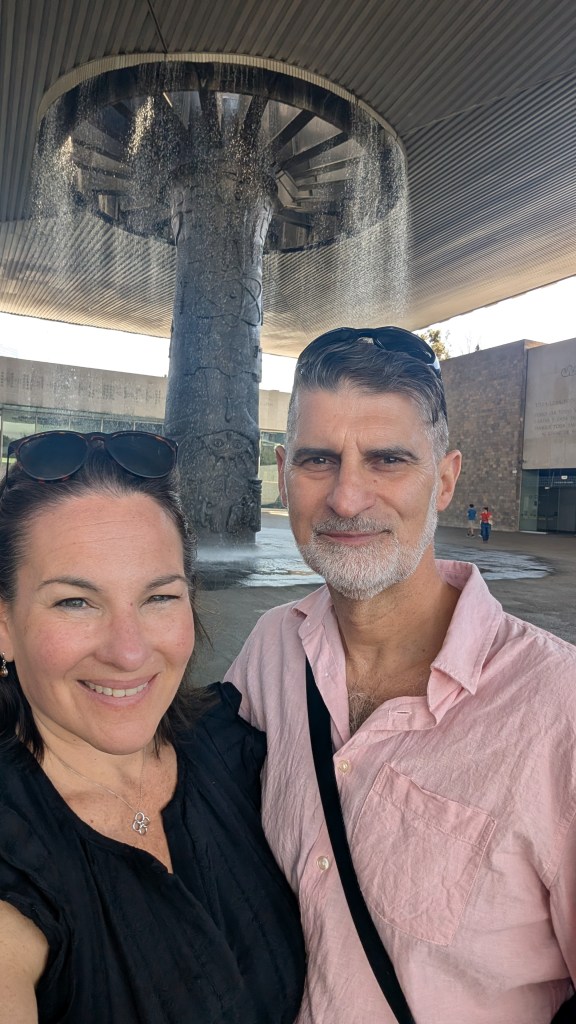
Thank you Todd and Ashley.
I love you Dawn.


Leave a Reply